

Lambani embroidery designs commonly combine geometric shapes, including squares, triangles, circles and rectangles, with diagonal and parallel lines, as described by The Indian Express. They can also incorporate patchwork, explained by D’source, and mirrors, beads, shells and coins, identified by AIACA.
Start with the shapes, stitchwork and arrangement. Understanding how they work together makes it easier to choose a garment placement and ask useful questions before buying.
How do you read Lambani embroidery designs?
Read a Lambani design at three levels: the shape you recognise, the stitches that build it and the way those shapes are arranged across the cloth.
- Motif: a recognisable design unit, such as a square, triangle, circle or diamond.
- Stitch: the way thread is worked through the cloth to make a line, outline, filling or texture.
- Composition: the arrangement of motifs, stitch lines, embellishments and unworked spaces across the textile.
A square can contain several kinds of stitching. Repeated stitch lines also form borders in their own right. To identify a stitch, look closely at the thread path within the shape.
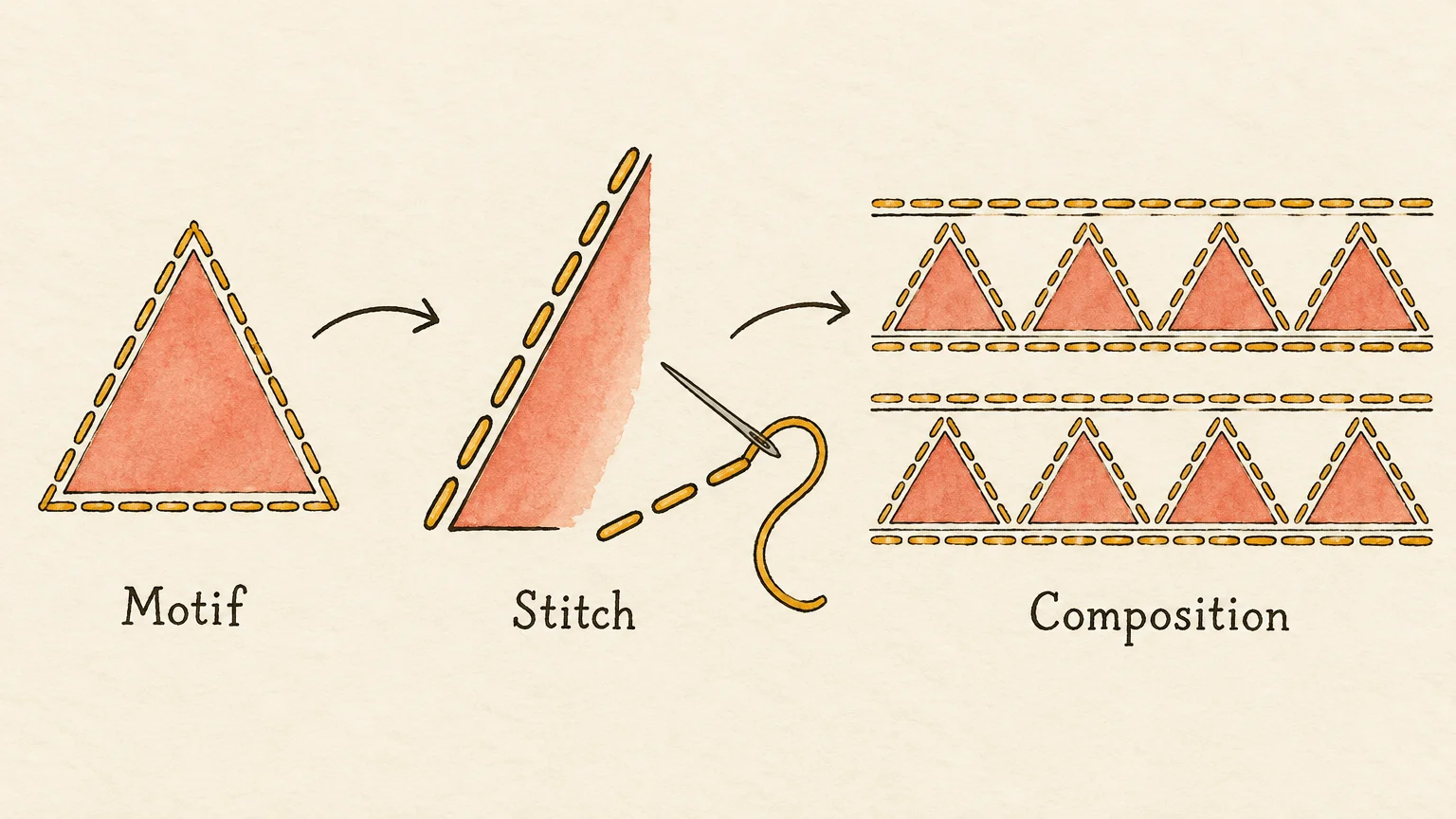
Bakkya, Maki, Jollya and Nakra are stitch names recorded by Dastkari Haat Samiti.
Geometric arrangements can also sit alongside floral or plant-inspired forms. A flower, triangle or circle does not automatically carry a fixed symbolic meaning: ask whether the maker has a specific name or explanation for that motif.
For the wider distinction between regional traditions, stitch techniques and embellishments, see our Indian embroidery types guide.
From narrow edgings to broad borders and panels
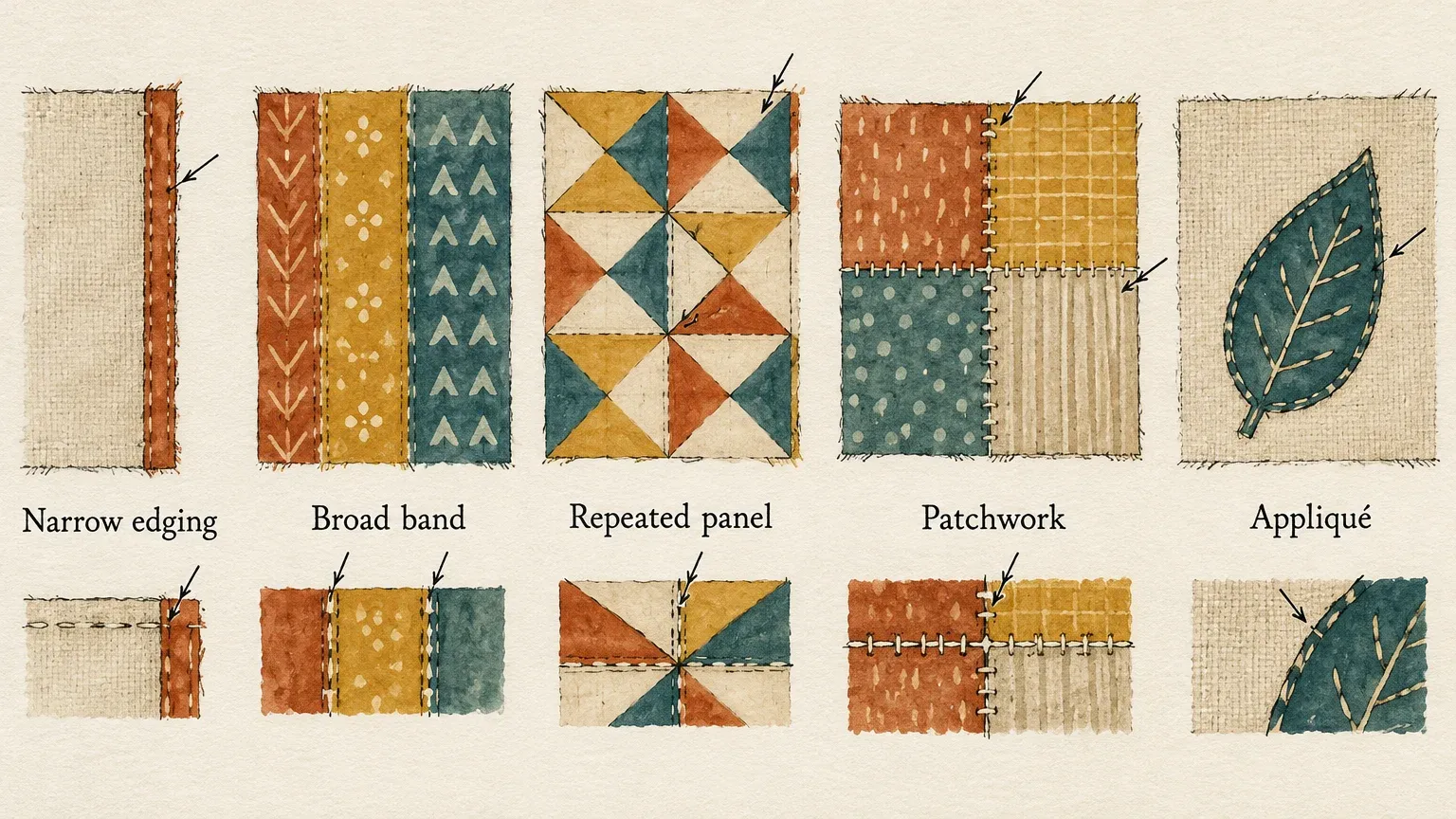
Narrow edgings follow an edge, broad borders gather several rows into a band, and panels concentrate the design within a defined area.
Repeated lines build an edge
A Sandur sample featured by Dastkari Haat Samiti combines zigzag, diamond and broad running-stitch lines with variations. Adjacent rows create width and rhythm.
These rows need not follow a rigid sequence. Dastkari Haat Samiti describes lines and patterns changing with the embroiderer’s imagination, skill and preferences. Spacing, direction and sequence can therefore vary within a larger piece.
Cloth pieces and embroidery do different jobs
Patchwork joins cloth pieces into a larger arrangement; appliqué attaches a smaller cloth piece to a base. Embroidery adds threadwork on or around that construction. D’source describes this smaller-piece-on-base method in Sandur work.
A blouse featured by Dastkari Haat Samiti combines patchwork, beads and mirrors. The joined fabric shapes form the underlying arrangement, with stitching and embellishments placed over them.
A repeated geometric panel, by contrast, describes the decoration within a bounded section of cloth, not how the cloth itself is joined.
Density, colour and embellishments change the composition
Dense embroidery creates a continuous decorative surface; an open composition leaves more base cloth visible between selected motifs or bands. Lambani work includes both approaches.
A woman’s dress described by Dastkari Haat Samiti has its available surface covered with thread embroidery, chains, buttons, shells, sequins and dangling silver beads. An urban outfit featured by the organisation has simpler ornamentation, with an emphasis on needlework quality.
Embellishments contribute more than decoration. Consider how each changes the surface or outline:
- Mirrors: reflective points within motifs, between bands or across a panel.
- Beads and shells: raised texture and emphasis around stitched areas or edges.
- Coins and tassels: hanging elements that can extend the composition beyond the cloth.
Colour and spacing determine how strongly these details stand out against the base cloth.
Choose placement for a blouse, jacket, skirt or dupatta
Match the area a composition covers to how the garment needs to move. For contemporary garments, consider these placements:
| Composition | Visible density | Possible placement | Intended use | Movement and construction questions |
|---|---|---|---|---|
| Narrow border | Concentrated along an edge | Blouse sleeve, neckline, shirt placket or dupatta edge | Restrained accent | Will the edge feel stiff or touch bare skin? How is its reverse finished? |
| Broad band | Concentrated across a strip | Jacket cuff, skirt hem or saree border | Framing and visual emphasis | Does it bend comfortably? Could hanging elements catch while walking? |
| Repeated geometric panel | Concentrated within a defined area | Blouse back, jacket yoke or tunic front | Focal detail | What are its dimensions? Does lining cover it, and does it cross seams or fastenings? |
| Patchwork or appliqué | Varies with cloth arrangement and stitching | Jacket panel, skirt section or dress bodice | Colour-blocked composition | How are joins finished? Is there room for alterations? |
| Dense all-over work | Extensive surface coverage | Statement jacket or selected dress and skirt sections | High-impact occasion wear | What is the garment’s weight? How does it feel at the waist, underarms and seated areas? |
For a celebration involving sitting, walking or dancing, request a movement video alongside posed photographs:
- Sit: check whether worked sections fold, press or bunch at the waist and hips.
- Walk: watch the hem, hanging embellishments and contact between garment layers.
- Lift your arms: check whether the neckline, yoke or underarm area pulls.
Comfort depends on the fabric, fit, lining and embellishment load.
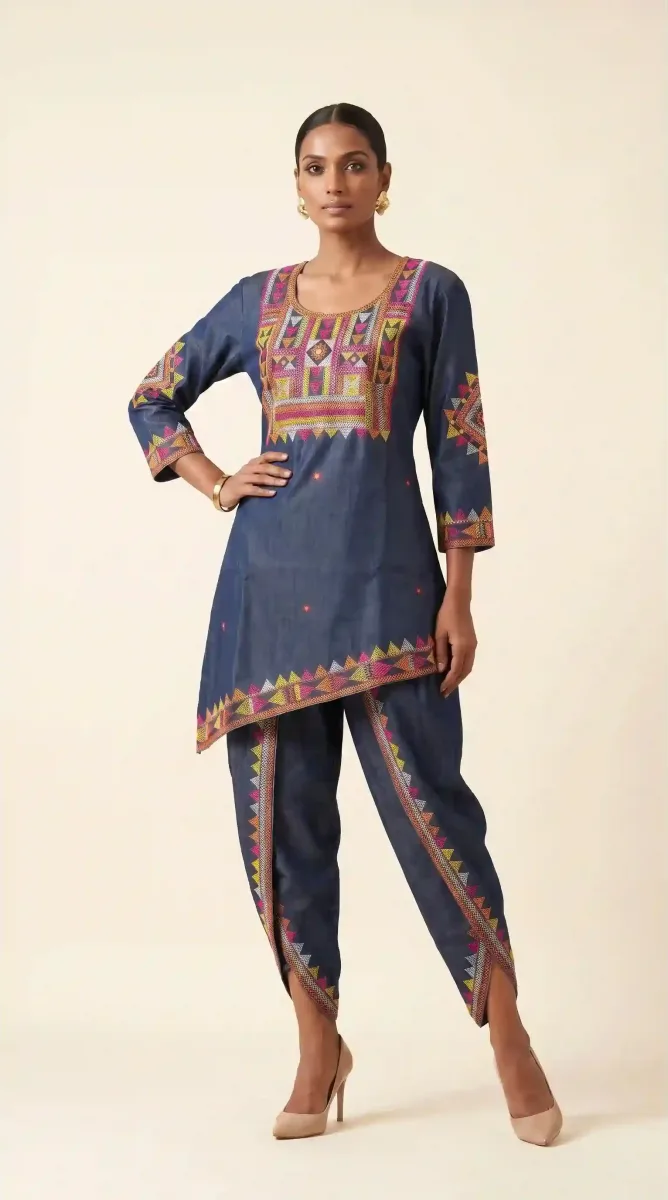
Our Blue Denim Lambani Tunic & Dhoti Set takes 66–73 artisan labour hours and uses 5 oz cotton denim with cotton lining. It requires dry-clean-only care. We make it to order in 4–5 weeks, with custom measurements and alteration support available. When comparing garments, consider labour time alongside visible density, and discuss panel positioning and the scope for alterations before construction.
What can photographs tell you about a Lambani piece?
Photographs can show layout, surface detail and some construction features. Ask the seller who made the embroidery and where the piece was produced, rather than relying on visual resemblance.
| What to request | What to look for | Follow-up questions |
|---|---|---|
| Full-piece photograph | Layout, placement and coverage | Who made it, and where was it produced? |
| Sharp stitch close-up | Thread paths, attachment and visible finishing | Which craft is used, beyond its visual resemblance? |
| Reverse-side photograph | Backing, joins and thread finishing | How does it feel and fit? Who made it? |
| Maker attribution | Who the seller credits | What was the artisan’s or organisation’s role in this piece? |
| Production-location information | Where the seller says this item was made | What item-specific production details support the location given? |
The DPIIT craft profile places Sandur Lambani embroidery in Karnataka’s Sandur region. Intellectual Property India’s GI register lists Sandur Lambani Embroidery as registered. For a particular garment, ask about its production location and the basis of any GI claim.
Mirrors are not exclusive to Lambani work: CBSE’s traditional textiles textbook also describes their use in Abhla Bharat. Neither reflective embellishments nor irregular stitch lines prove provenance.
Call each craft by its own name. Lambani embroidery, mirror work and Zardosi are not interchangeable labels; ask which work is present. Our comparison of Lambani embroidery and mirror work explains that distinction further.
Questions to send the seller
Send these questions with the design you like:
- Who made the embroidery, and where was this piece produced?
- What are the panel dimensions and finished garment measurements?
- What is the base fabric, backing and lining?
- How are mirrors, beads, shells, coins or tassels secured?
- Can you share full-piece, close-up and reverse-side photographs, plus a movement video?
- What care does this particular garment require?
- Which alterations are possible without cutting through or moving the embroidery?
Use these questions when exploring our Lambani collection, too, so you can choose a composition that suits both your style and how you plan to wear it.