
Well-known Indian embroidery types include Lucknow’s delicate Chikankari, Punjab’s bright Phulkari, Bengal’s running-stitch Kantha, Kashmir’s floral embroidery and metallic Zardozi associated with Uttar Pradesh and Madhya Pradesh. The V&A’s embroidery guide describes Chikan’s fine cotton whitework, while the Development Commissioner (Handicrafts) identifies regional Zardozi crafts in its Indian embroidery catalogue. Recognising these differences helps you understand what a garment label actually promises.
Other important names include Sujini, Kutch embroidery, Kasuti, Toda, Parsi Gara and Banjara/Lambani. These labels can refer to traditions, communities, techniques or materials.
Indian embroidery types at a glance
Compare Indian embroidery styles by their appearance, regional associations and what each name describes. A region points to a craft connection, not necessarily where an individual garment was made.
| Name | What the name describes | Associated region or community | Defining appearance | Common applications |
|---|---|---|---|---|
| Chikankari | Named craft tradition | Lucknow, Uttar Pradesh | Delicate whitework, shadow effects, raised details and openwork | Kurtas, shirts, saris, dupattas |
| Phulkari | Named craft tradition | Punjab and neighbouring northern regions | Lustrous darning-stitch patterns, often geometric or flower-like | Shawls, dupattas, stoles, saris |
| Kantha | Named craft tradition | West Bengal; wider tradition in Bangladesh | Running-stitch texture, quilting and pictorial designs | Quilts, covers, saris, garments |
| Sujini or Sujani | Named craft tradition | Bihar | Running-stitch surfaces and narrative imagery | Quilts, covers, wall textiles |
| Kashmiri embroidery or Kashida | Broad regional craft label | Kashmir, Jammu and Kashmir | Flowers, paisleys, leaves and other natural imagery | Shawls, garments, furnishing textiles |
| Kutch embroidery | Regional family | Kutch, Gujarat; several communities | Varied geometric and floral styles, sometimes with mirrors | Garments, accessories, decorative textiles |
| Zardozi or Zardosi | Named metallic-embroidery craft | Lucknow, Bareilly, Varanasi; Bhopal, Gwalior, Indore | Metallic decoration, often raised and dimensional | Festive garments, ceremonial textiles, contemporary separates |
| Kasuti | Named craft tradition | Karnataka, particularly Dharwad | Counted-thread geometric and architectural motifs | Saris, especially pallus; garments |
| Toda | Community-associated tradition | Toda community, Nilgiri Hills, Tamil Nadu | Red-and-black geometry on a light cotton ground | Shawls, wraps, contemporary accessories |
| Parsi Gara | Community-associated tradition | Parsi communities, Gujarat and Maharashtra | Detailed flowers, birds, animals and figures | Saris, borders, garments |
| Banjara/Lambani | Community-associated traditions | Communities across regions; Sandur, Karnataka, is a named centre | Colourful stitching with varied mirrors, shells or coins | Clothing, bags, decorative textiles |
| Aari or Ari | Technique | Kashmir, Gujarat and other centres | Linked chain stitches formed with a hooked tool | Garments, shawls, furnishing textiles |
| Mirror work or Shisha | Overlapping embellishment | Prominent in Gujarat and Rajasthan; also elsewhere | Reflective pieces secured within stitching | Garments, accessories, decorative textiles |
| Gota Patti | Stitched ribbon appliqué | Strongly associated with Rajasthan | Metallic ribbon pieces arranged into decorative shapes | Saris, dupattas, festive garments |
| Zari | Material description | Used across regions | Metallic thread or yarn | Embroidery, woven textiles, borders |
| Resham | Material description | Used across regions | Silk-thread colour and lustre | Embroidered garments and other textiles |
A short label glossary:
- Tradition: a named craft practice, such as Chikankari or Kantha, with its own history and visual vocabulary.
- Region: a geographical association. Kutch is a regional family.
- Community: the people associated with a tradition, as with Toda or Lambani embroidery.
- Technique: how decoration is constructed. Aari describes hooked-tool work.
- Material: what is used. Zari and resham describe metallic and silk threads respectively.
- Embellishment: an added decorative element, such as mirrors or stitched ribbon.
A garment can carry several of these labels accurately. For example, a regional tradition may use Aari stitching, silk thread and mirrors. Ajrakh belongs to printing, while Bandhej and Shibori are resist-dyeing techniques.
A maker’s background can also differ from the making location. Our Indian embroidery artisan stories introduce Shambu Adhikary, originally from Kolkata and now working across Bhopal and Indore.
Chikankari and Phulkari: whitework and bright northern textiles
Chikankari: Lucknow, Uttar Pradesh
Chikankari is recognised by delicate floral stitching, traditionally white on a light ground, with several different surface effects. India.gov.in’s Lucknow craft profile identifies the city with both Chikankari and Zari Zardozi.
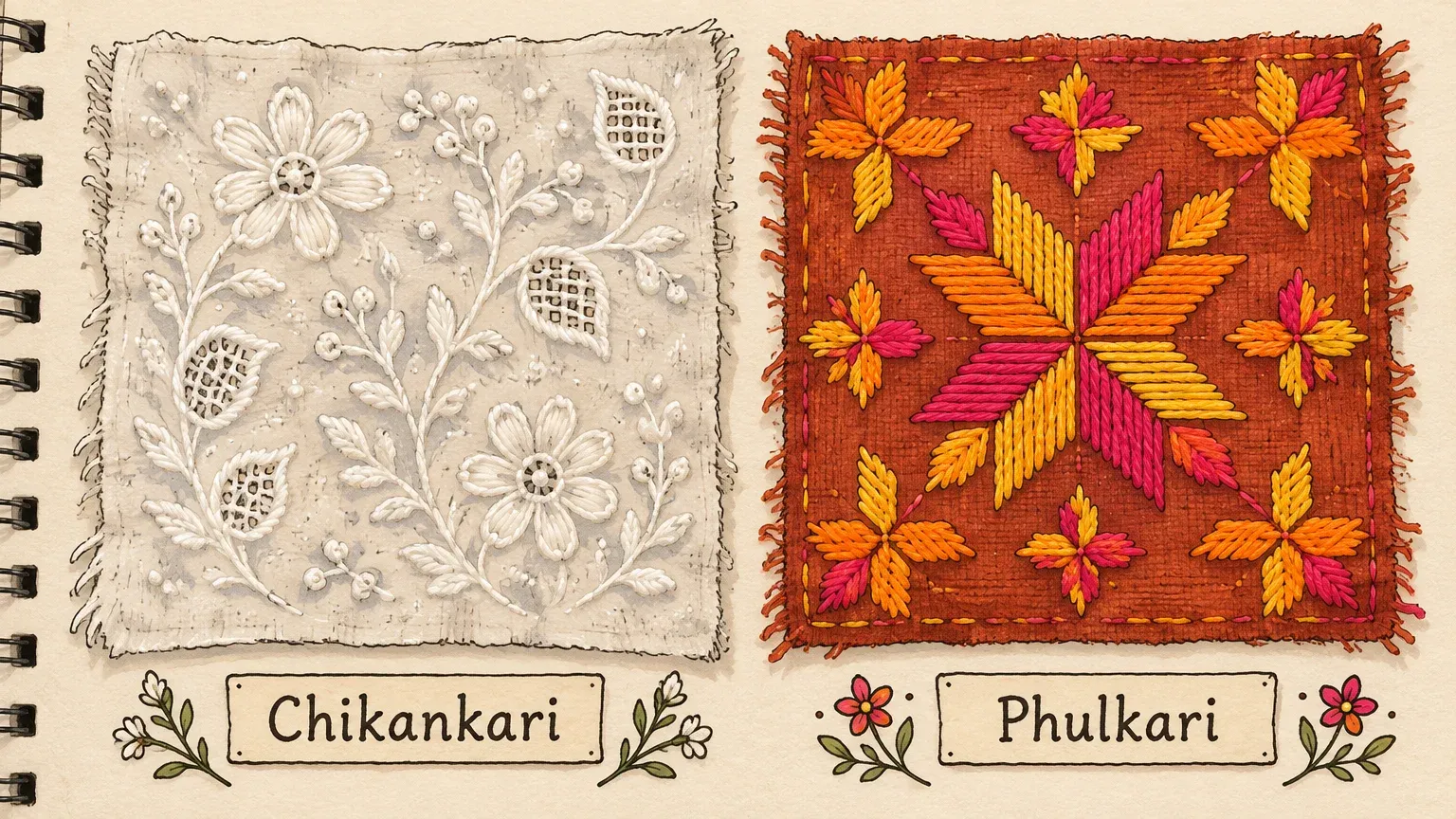
Look for soft shadow effects, tiny raised details and open areas that resemble a fine mesh. Labels may name bakhiya for shadow work, phanda and murri for raised details, and jaali for openwork. These are stitch names within Chikankari.
Fine cotton is central to its traditional appearance, but modern Chikankari also uses coloured grounds and threads.
Phulkari: Punjab and neighbouring northern regions
Phulkari is recognised by bright, lustrous thread patterns, often geometric or flower-like, built with repeated darning stitches. Silk floss gives the worked areas their characteristic sheen.
Bagh is densely covered work within the broader Phulkari tradition.
D’source’s Phulkari textile guide lists shawls, dupattas, stoles, saris and bed covers among its uses. When choosing clothing, consider fabric and coverage as well as the craft name: an airy Chikankari shirt and a densely worked Phulkari wrap can feel very different.
Kantha and Sujini: running-stitch textiles with different identities
Kantha is associated with Bengal, while Sujini belongs to Bihar’s craft heritage; both use running stitches. IIAS’s Kantha regional study places Kantha in West Bengal and across much of Bangladesh.
Kantha’s running stitches create rippled surfaces, quilting lines and pictures. Animals, trees, boats and everyday scenes can appear alongside repeating patterns. Layering and reusing older cloth are important to its history: Asia InCH’s Kantha craft account describes discarded sari fragments being layered and sewn into a single textile surface.
Today, Kantha appears on saris, shawls and garments as well as quilts and covers.
The Government of Bihar identifies Sujani, also written Sujini, as a Bihar craft. Look for running-stitch surfaces and narrative imagery.
You may encounter the phrase seven types of Kantha. In Fibre2Fashion’s Kantha heritage article, these are grouped by end use, not by seven stitch techniques.
Kashmiri embroidery: Kashida, Sozni, Aari and Tilla
Kashida is a broad label for embroidery in Kashmir; Sozni, Aari and Tilla distinguish the work by tool, material and appearance.
Asia InCH’s Kashmir embroidery guide uses Kashida as the general term, with motifs including almonds, chinar leaves, lotus and cypress cones. Floral sprays and paisleys are further visual clues. To distinguish the techniques, look at the stitching and thread as well as the motifs.
- Sozni: fine needle embroidery with finely drawn, detailed patterns. The District Srinagar administration’s Srinagar craft guide associates it with shawls and garments.
- Aari: linked chain stitches made using a hooked tool. Look for a chain-like line within the floral design.
- Tilla: metallic embroidery, giving patterns a more reflective, lustrous surface.
Aari is also practised beyond Kashmir. Shawls, woollen garments and furnishing textiles may share Kashmiri motifs while differing substantially in thread, tool and construction. Ask which technique is used when a label says only “Kashmiri embroidery”.
Kutch, Lambani and mirror work: region, community and embellishment
Kutch embroidery: Gujarat
Kutch embroidery is a regional family containing several community practices, not a synonym for mirror work. Asia InCH’s Kutch embroidery account traces the development of different styles as pastoral communities migrated across Gujarat.
Names you may encounter include Rabari, Ahir and Suf. Rabari work often has bold forms and mirrors; Ahir work is associated with flowing floral imagery; Suf is noted for counted, angular geometry.
Banjara and Lambani: communities across regions
Banjara and Lambani embroidery belong to community traditions practised across regions. The Development Commissioner (Handicrafts) lists Sandur Lambani embroidery as a named craft, with Sandur in Karnataka as a centre.
Colourful stitching can be combined with mirrors, shells, coins and patchwork. The combinations vary between textiles and makers.
Mirror work: an overlapping embellishment
Mirror work, also called Shisha, describes reflective pieces secured within stitching. It appears within several traditions, particularly those associated with Gujarat and Rajasthan.
Zardozi, Kasuti, Toda, Parsi Gara and Gota Patti
Zardozi and Gota Patti: different forms of metallic decoration
Zardozi is metallic embroidery, often dimensional; Gota Patti is decoration made by stitching ribbon pieces onto fabric.
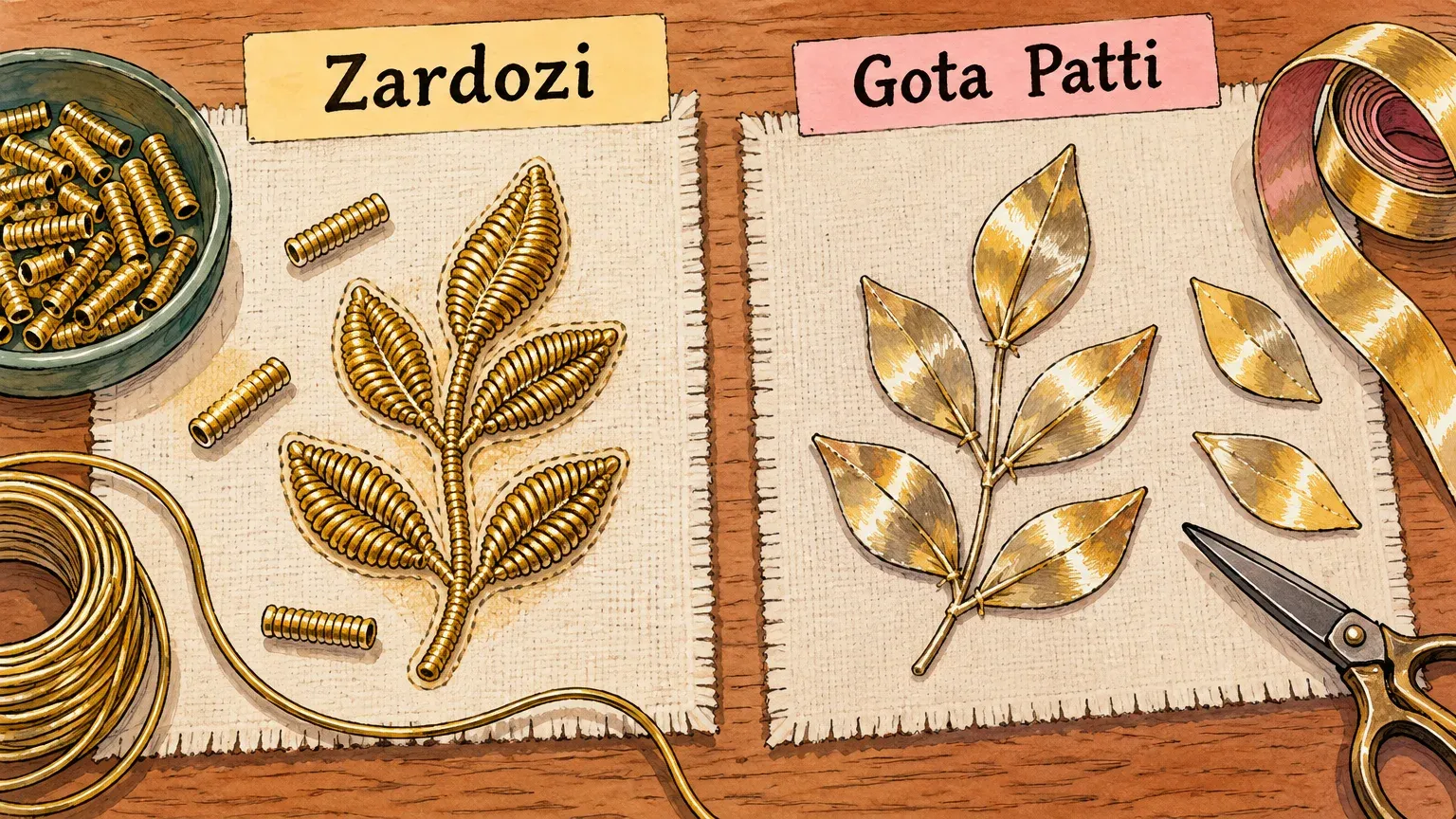
Zardozi, also spelled Zardosi, is associated with Lucknow, Bareilly and Varanasi in Uttar Pradesh. The Development Commissioner’s Zari Zardozi profile also identifies Bhopal, Gwalior and Indore in Madhya Pradesh.
Look for metallic lines and raised details. The government’s Lucknow Zardozi profile explains that dabka uses coiled thin wire to create textured metallic decoration.
Zari describes material; Zardozi names a craft. Resham describes silk thread. These labels can appear together on a garment.
Gota Patti is strongly associated with Rajasthan. The Rajasthan government’s Gota Patti guide describes stitching gota onto fabric. The ribbon pieces form decorative shapes, making this a type of appliqué.
Both appear on festive and ceremonial clothing. Their weight depends on the amount and placement of decoration: restrained work on a collar, cuff or border differs from extensive coverage across an entire outfit.
Kasuti, Toda and Parsi Gara: distinctive visual traditions
Kasuti is recognised by precise counted geometry, Toda by contrasting geometric bands, and Parsi Gara by detailed pictorial embroidery.
Kasuti: the government’s Dharwad Kasuti profile links it with Karnataka and geometric patterns on silk pallus. IGNCA’s Mapping Indian Textiles explains its careful counting of warp and weft threads. Architectural motifs are part of this precise pattern work.
Toda: Isha’s Toda community profile associates the craft with the Toda people of Tamil Nadu’s Nilgiri Hills. The Delhi Crafts Council’s Toda embroidery profile describes red-and-black geometry, occasionally blue, on unbleached white cotton.
Parsi Gara: associated with Parsi communities in Gujarat and Maharashtra, it features detailed floral and bird imagery. Asia InCH’s Parsi embroidery account also includes animals and human figures.
A contemporary example: Zardosi on our shirt
Our Blue Modal Silk Zardosi Work Shirt brings traditional hand embroidery to a contemporary silhouette. We create authentic handicrafts in Indo-Western forms while retaining each craft’s identity.
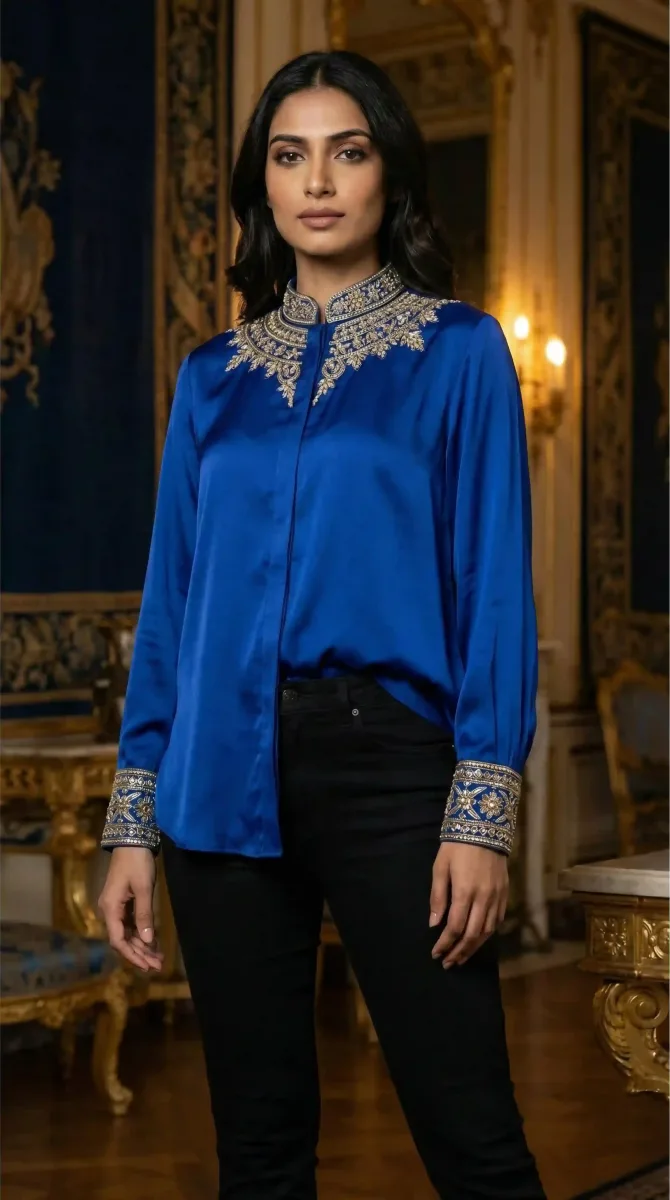
The shirt is made in Bhopal from Modal Silk, with hand embroidery led by Shambu Adhikary. It carries 43–48 artisan hours, recorded using our ₹200–₹220 hourly artisan-compensation benchmark.
It is priced at ₹9,450 and made to order in 4–5 weeks.
What can appearance tell you about embroidery?
Motifs, texture and embellishments offer clues to an embroidery style. For hand or machine execution, material composition and making location, look to the maker’s garment details.
| Visible clues | Details to ask the maker |
|---|---|
| Floral, pictorial or geometric motifs | Named tradition and maker or community attribution |
| Running-stitch lines or rippled texture | Hand or machine execution and layered construction |
| Raised metallic decoration | Metal composition, thread type and named craft |
| Mirrors or reflective pieces | Community association and making location |
| Apparent ribbon appliqué | Ribbon material and construction details |
Read an embroidery label in three steps:
- Identify whether the name describes a tradition, community, technique, material or embellishment.
- Compare the garment’s visible features with that description.
- Check the maker’s garment details for production location, materials and hand or machine execution.
A contemporary garment may combine several crafts or materials. A single label may refer to just one decorated area, so consider its placement as well as the overall design.
Choose your next question according to what you want to understand:
- Hand versus machine: how was this particular piece made?
- Zari versus Zardozi: does the label identify a material or a craft?
- Mirror work: how are the reflective pieces incorporated?
- Lambani buying details: who made the piece, which community is associated with it, and where was it made?
For a contemporary application of traditional hand embroidery, explore our Zardosi shirts and separates.