

To choose sustainable clothing in India, compare each garment’s composition, supporting evidence, production details, fit, care and likely repeat use. India’s CCPA greenwashing guidelines require environmental claims to be substantiated with credible evidence.
For example, our Blue Zardosi shirt costs ₹9,450 and takes 4–5 weeks to make, with custom-fit support.
The evidence to check before buying
Ask for evidence that matches the exact claim. You may want to reduce the environmental impact of clothing production, support safe and fairly paid work, or help sustain craft skills and artisan livelihoods. For environmental impact, look for documented material sourcing, processing and measured outcomes. For worker welfare, ask about payment, hours and safety. For craft continuity, look for named makers, techniques and ongoing artisan work. Gujarat Tourism’s handicraft programme connects its activities with artisan employment and income generation.
| Claim | Useful documentation | What it tells you | What else to check | Question to ask |
|---|---|---|---|---|
| Material composition | Fibre percentages for fabric, lining and significant trims | What the garment contains | Processing and garment-level environmental impact | What are the exact percentages? |
| Organic or recycled | Applicable certificate, composition and product coverage | The covered input or product claim | Coverage of the finished garment | Does this garment fall within the certificate? |
| Handcrafted or handloom | Technique, maker and making location | A craft or production attribute | Payment, pollution and durability | Which stages are done by hand? |
| Ethical working conditions | Payment, hours, safety and relevant social-standard records | The documented working arrangements | Conditions across production stages | How are workers paid and protected? |
| Made-to-order or custom fit | Measurement checks, alteration and production terms | The ordering and fit process | Evidence for any waste-reduction claim | What happens if the fit is wrong? |
| Lower environmental impact | Measurement method, comparison and production boundaries | The specific measured difference | Which impacts and stages were measured | Lower than what, and across which stages? |
A fabric claim needs a closer look when it is used to describe the finished garment. Check embroidery, lining, dyeing and assembly too.
How can you verify a garment’s certification?
Check the certificate or label number through the scheme’s official resources, then confirm that it covers your chosen garment and the claim being made.
| Scheme | What it covers | What to check |
|---|---|---|
| GOTS key features | Organic grade: at least 95% certified organic fibres. Made with Organic Materials: at least 70%. | Finished-garment certification requires product coverage. |
| OEKO-TEX STANDARD 100 | Textiles tested for harmful substances | Environmental and labour claims require their own evidence. |
| Textile Exchange’s GRS guidance | 50% minimum recycled content, plus processing, chemical-use and social requirements | Check coverage of the particular product and claim. |
GOTS labelling guidance prohibits presenting partial certification as full product certification and includes social requirements covering safe conditions and prohibitions on child and forced labour.
- Request the scheme name and certificate or label number.
- Check the holder, validity and covered products or processes.
- Match that coverage to the seller’s wording and your chosen garment.
Use the OEKO-TEX Label Check with its case-sensitive label numbers.
Match the material to the garment and your routine
Natural fibres are not automatically better than synthetic or regenerated fibres. The European Environment Agency’s fibre review explains that the answer depends on the environmental impact being compared. Start with composition and intended use, then examine processing and care.
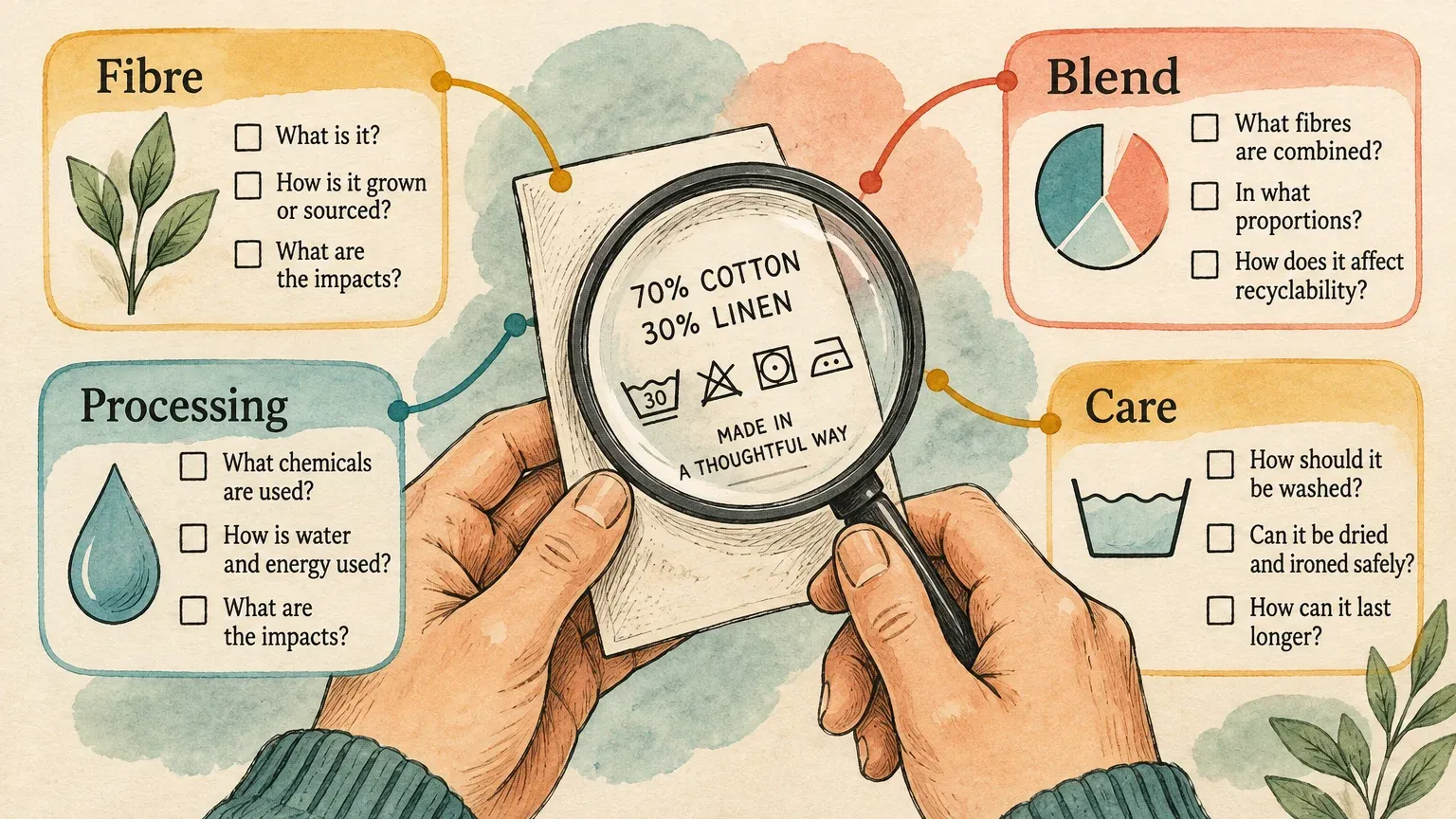
| Material | Appeal or use to assess | Composition and processing check | Care check |
|---|---|---|---|
| Cotton | Everyday shirts and dresses: assess comfort, weight and opacity | Exact blend, fabric weight and evidence for organic claims | Washing instructions and shrinkage guidance |
| Linen | Warm-weather and office clothing: assess comfort and acceptable creasing | Pure linen or blend; fabric weight and finishing | Washing and ironing requirements |
| Hemp | Everyday clothing; cultivation-related appeal | Hemp percentage, other fibres and processing disclosure | Finished garment’s washing instructions |
| Recycled polyester | Activewear or travel: check stretch, drying performance and crease recovery | Recycled percentage and supporting documentation | Permitted washing and drying temperatures |
| Modal | Tops and dresses: assess softness, drape and opacity | Exact blend and processing disclosure | Whether washing or dry cleaning is required |
| Bamboo-derived fabrics | Next-to-skin everyday wear: assess comfort and washability | Whether it is bamboo-derived rayon or another fibre form | Instructions for the actual finished fabric |
Hemp grows quickly, resists many insect species and often needs little cultivation water, according to Textile Exchange’s hemp guidance. Check how the fibre is processed and how the finished garment performs.
Textile Exchange’s modal definition identifies modal as regenerated cellulose and a variation of rayon or viscose. The FTC’s bamboo guidance explains that bamboo can supply material for rayon. For a blend marketed as “Modal Silk”, request the fibre percentages.
Choose for your routine: an office shirt needs comfortable movement and manageable creasing; everyday clothing needs care you can maintain; festive clothing needs suitable drape and embellishment care. Recycled content describes the material, while performance depends on the finished fabric and garment.
Trace the making locations, not just the Indian label
Ask about five stages of production to trace the garment from fibre to finished piece:
- Fibre: where it was grown, sourced or recycled.
- Fabric: where it was woven or knitted.
- Dyeing or printing: where colouring and finishing happened.
- Embroidery: who completed the work and where.
- Assembly: where the garment was cut and stitched.
Tiruppur is a leading source of hosiery, knitted garments, casual wear and sportswear, according to PIB’s Tiruppur account. Gujarat Tourism’s Patola guide identifies Patan with double-ikat patola. These regional textile traditions are a starting point for asking where a garment is made and what environmental controls are used.
Our craft connections include Lucknowi and Bhopali zardosi. Shambu Adhikary creates the zardosi for our Blue Zardosi shirt in Bhopal, with 43–48 artisan hours of work. You can meet our craft artisans, then ask about payment arrangements, working hours and safety.
Handcrafted means handwork; handloom means weaving by hand; made-to-order means production begins after an order. Check working conditions, environmental measurements and repair support alongside these production methods.
Where to shop for sustainable clothing in India
Start with EarthBased’s Sustainable Clothing collection for everyday options and our handcrafted occasionwear for festive dressing. Choose a garment category first, then check its material, evidence and buying terms.

| Garment or category | Material and making | Before buying |
|---|---|---|
| EarthBased Sustainable Clothing collection | Bamboo, hemp-cotton and recycled-fibre options; check individual listings for production details | Check the chosen garment’s price, certification number and product coverage. |
| Our Blue Modal Silk Zardosi Work Shirt: ₹9,450 | Modal Silk; named Bhopal artisan and 43–48 artisan hours | Request fibre percentages and supporting evidence for any environmental claim. |
| Our CHANDNI RAAT blazer set: ₹32,500 | Handcrafted, made-to-order blazer set | Confirm composition, garment measurements and care. |
| Option | Fit and care | Production and delivery |
|---|---|---|
| EarthBased everyday collection | Check the chosen garment’s sizing and care instructions. | Check production and dispatch timing, and confirm arrival for your postcode and required date. |
| Our Blue Zardosi shirt | XS–6XL and custom measurements; dry clean only | 4–5 weeks of making; confirm transit and arrival date |
| Our CHANDNI RAAT blazer set, available in our online catalogue | Confirm garment measurements and care before ordering. | 4–5 weeks of making; confirm event delivery |
For Gujarat handloom, explore Garvi Gurjari. Gujarat Tourism’s handicraft programme offers regional craft context; check current garment listings and buying terms before ordering.
Check the garment-specific label number for EarthBased’s OEKO-TEX reference. For handloom purchases, obtain the chosen garment’s sizing, delivery and return terms before paying.
Our shirt can be combined with existing clothes, while our blazer set offers a coordinated occasionwear outfit. Compare each against your planned occasions, maintenance budget and likely repeat use.
Compare fit, deadlines and cost per wear
Check fit and event timing
Check garment measurements and movement before ordering, and allow for making time plus transit. Assess an everyday shirt for routine wear and an embellished festive piece for your intended occasions.
We offer measurement review, custom-measurement support and a complimentary WhatsApp fit consultation. Our shirt’s terms provide a remake for our measurement error and one complimentary alteration for incorrect customer measurements. Confirm cancellation terms, custom-order return eligibility and event-date delivery before paying.
Read care instructions for washing, bleaching, drying and ironing, the domestic treatments covered by ISO’s care-labelling standard. Dry-clean-only care adds cost and effort. Ask about embellishment repairs and alterations before buying.
Calculate purchase value
Divide purchase price plus expected care and alteration expenses by realistic wears. Plan outfits around pieces you already own, and keep the estimate achievable.
Cost-per-wear examples: everyday clothing and occasionwear
Assume an everyday purchase costs ₹3,000 and is worn 30 times, excluding care and alteration expenses: ₹3,000 ÷ 30 = ₹100 per wear.
Assume an occasionwear purchase costs ₹9,000 and is worn 15 times, excluding care and alteration expenses: ₹9,000 ÷ 15 = ₹600 per wear.
Add expected cleaning and alteration costs before dividing. Cost per wear measures purchase value, not carbon emissions, water use or environmental impact.
Frequently asked questions
Is Zara a sustainable brand?
Assess the specific Zara garment rather than relying on a collection label or brand-wide statement. Check its composition, certification coverage and evidence behind any environmental claim. Then consider whether its fit, care requirements and likely repeat use suit your needs.
Is Myntra eco-friendly?
Assess the individual brand and garment on Myntra using the same checks you would apply elsewhere. Look for material percentages, certification coverage and evidence behind environmental claims. Check the seller’s sizing, care, delivery and return terms before purchasing.
Your final decision: buy, ask or skip
- Buy when evidence, fit, care, budget and timing meet your needs.
- Ask when composition, certification coverage or buying terms are unclear.
- Skip when the seller cannot substantiate a claim decisive to your purchase.
For handcrafted occasionwear, explore our collections and fit support to find a piece whose craft, care and making time suit your plans.