
Wash embroidered clothes at home only when the complete garment’s care instructions permit it. Even hand washing must suit the whole piece, not just its embroidery. GINETEX’s care-symbol guide says care reflects the most sensitive part; our modal silk Zardosi shirt is dry clean only.
For home washing, you’ll need a clean basin, a compatible cleanser and suitable drying support. If washing is unsuitable, choose an explicitly permitted surface treatment or consult a specialist. Take the label, garment construction details and stain history to the cleaner. Follow any washing or soaking limits, and dry the garment only as instructed.
1. Read the complete care label before adding water
Read every instruction together: the label covers the complete garment, including its main fibre, embroidery and attachments. The FTC’s care-labelling guidance includes non-detachable linings, trim and other details.
- Washing: Is home washing permitted, and by which method?
- Temperature: What water-temperature limit applies?
- Bleaching: What restrictions are stated?
- Drying: Which method, position and conditions are allowed?
- Ironing: Is pressing permitted, and at what setting?
- Professional care: Which processes are permitted or prohibited?
Numbers inside the washing tub indicate a maximum temperature, according to the GINETEX symbol chart.
Hand washing is not automatically safer than the specified machine cycle. Follow the labelled method and respect any washing prohibition. If instructions are missing or conflicting, pause and consult the maker or a suitable cleaner.
2. Inspect the construction and choose your care route
Alongside the label, inspect the fibre composition, embroidery threads, metallic Zardosi or zari, mirrors, beads, linings, interfacing and tailoring. A cotton or denim base does not make its embellishments washable. Silk, modal silk and tissue pieces also need care suited to the whole garment.

| Route | When to choose it | What to do |
|---|---|---|
| A: Home washing | Complete-garment instructions permit washing; attachments are sound | Use the specified washing and drying methods |
| B: Limited surface care | Maker explicitly permits the particular treatment | Treat only the permitted area using that method |
| C: Maker or professional advice | Washing is restricted; materials, instructions or construction need assessment | Present the label and garment before treatment |
Stop and seek advice if you find colour transfer, loose or broken attachments, distortion or materials you cannot identify.
These three garments from our collection require dry cleaning:
| Our garment | Construction | Care instructions |
|---|---|---|
| Blue Modal Silk shirt | Modal silk with Zardosi hand embroidery | Dry clean only |
| PACHRANG mirror-work set | Handloom tissue silk jacket and pant with mirror work | Dry clean only |
| KAJRI Zardosi blazer set | Handloom tissue silk blouse, draped skirt and blazer with Zardosi hand embroidery | Dry clean only |
Assess every component of a set. Dry-clean-only instructions take priority over general advice on washing silk.
3. Prepare washable pieces and check stains
Turning a flexible garment with ordinary stitched embroidery inside out can reduce rubbing during label-approved machine washing. Do this only if the label permits it and the attachments remain free of strain. Do not force rigid embellishments through a narrow opening or turn a piece if doing so catches delicate attachments.
- Inspect stitches and attachments for damage before proceeding.
- Empty pockets and secure fastenings away from the embroidery.
- Keep contrasting pieces apart. The American Cleaning Institute’s laundry guide recommends sorting by colour, fabric type and washing instructions.
- Carry out any hidden colour-transfer check recommended by the maker.
A successful hidden test checks only the tested area. It does not override the complete garment’s care instructions.
For sweat, makeup, food or oil stains, record the cause and any previous treatment. Avoid experimenting with cleaners, and seek specialist advice for uncertain materials or embellished areas. Where surface care is explicitly permitted, follow that method. The DLI stain-care guide advises blotting stains rather than rubbing them.
4. Hand wash embroidered clothes only when permitted
Follow these steps only if the garment’s care instructions allow hand washing.
- Prepare the basin. Use a clean basin spacious enough to spread the garment and handle its embroidery gently.
- Prepare the water. Stay within the stated temperature limit and choose a cleanser compatible with the garment instructions.
- Measure the cleanser. Follow the cleanser’s hand-wash dosing instructions and the garment’s restrictions, as recommended by the American Cleaning Institute’s laundry guide. Mix the measured cleanser into the water before lowering the garment.
- Lower and support the garment. Cradle the whole piece and gently move it through the water, keeping the embroidered area open and relaxed. Avoid rubbing or bunching the stitches.
- Follow soaking limits. If the instructions allow soaking, keep to any stated duration.
- Rinse gently. Support the whole garment during lifting and rinsing. Move it gently through rinse water within its temperature limits until the cleanser is removed.
5. Remove excess water and dry without stretching
Support the wet garment’s weight across your hands and forearms when lifting it, keeping strain away from its shoulders, neckline and embroidered edges. Avoid twisting or wringing the embroidery.
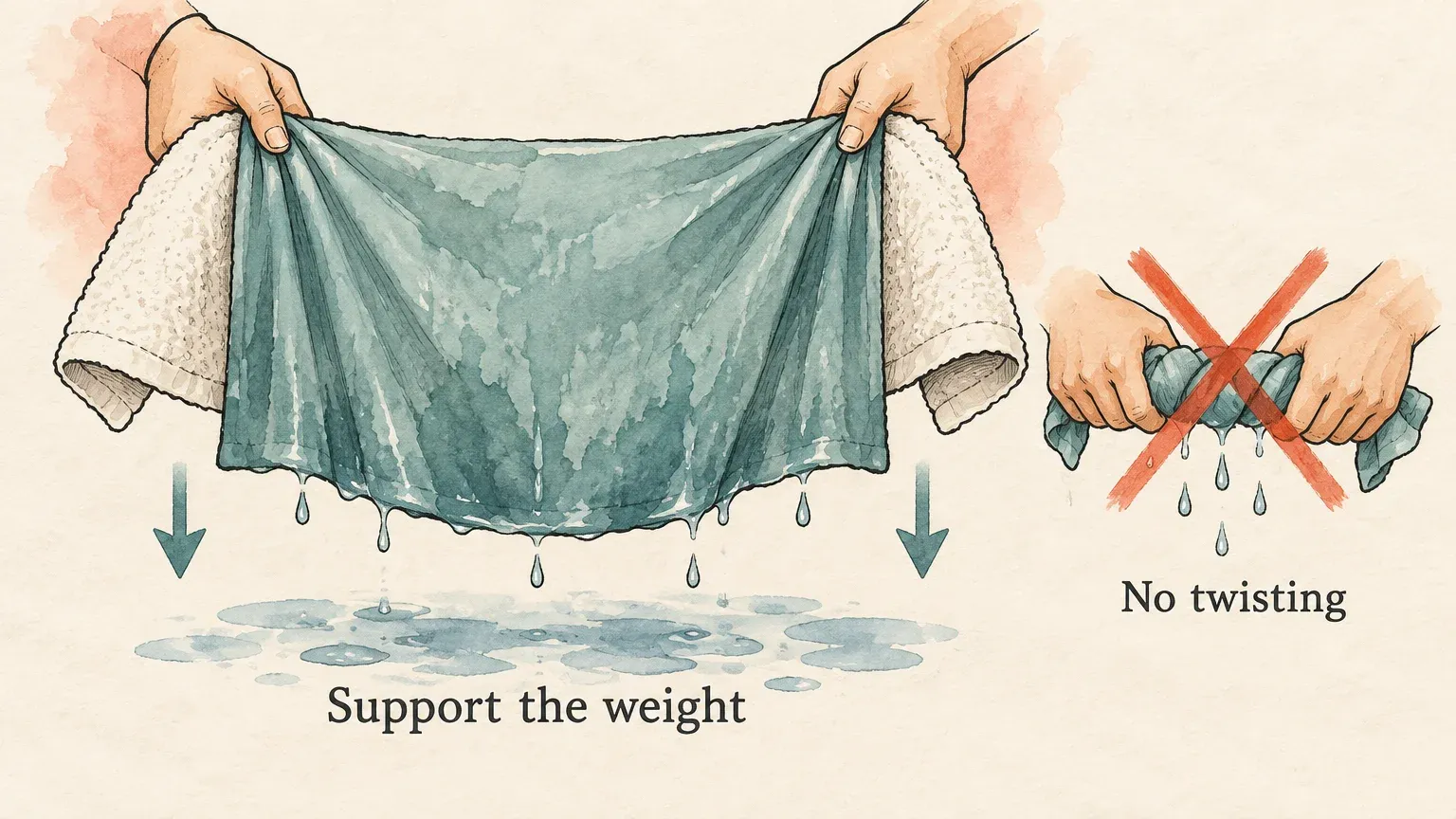
- Use gentle pressing or towel-assisted water removal only when compatible with the garment instructions.
- Transfer the supported piece to its prescribed drying position. Restore its shape gently without stretching.
- Follow shade, line-drying, flat-drying or tumble-drying instructions as stated.
- Let the fabric, construction and permitted drying conditions determine how long it takes to dry.
The GINETEX symbol chart distinguishes natural-drying positions. Its care-labelling system guide explains ironing-temperature dots. Check pressing instructions separately and obtain the maker’s guidance before applying an iron to embellishments.
6. Brief a specialist cleaner when home washing is unsuitable
Choose a cleaner willing to assess the embroidery, attachments and structure before accepting the garment. Provide:
- The complete label and available fibre information.
- Every set component, including a blouse, draped skirt and blazer where applicable.
- Details of metallic work, mirrors, beads, linings, tailoring and detachable parts.
- The stain’s cause, when it happened and every treatment already applied.
- Details of loose stitches, insecure attachments, distortion or previous colour transfer.
DLI’s stain guidance recommends identifying spills even when the mark is no longer visible. Its bead and sequin guidance stresses testing before professional cleaning. Ask how sensitive attachments will be assessed.
Professional care can mean dry cleaning or professional wet cleaning, but each process must be permitted by the garment’s instructions. GINETEX’s professional-care guidance states that household washing machines cannot reproduce professional wet-cleaning requirements.
Do not wash solely to meet a schedule, but assess soiling promptly. DLI’s garment-care tips warn that perspiration and body oils can weaken fabric and change colour over time.
Keep this printable garment-care card
Garment: record its name or description.
Complete label wording: copy every instruction.
Fibre composition: copy the available fibre information.
Embroidery, attachments, lining and structure: list each feature.
Set components: list all pieces.
Stains and previous treatments: record the cause, timing and products applied.
Chosen route: A, permitted washing; B, explicitly permitted surface care; C, maker or professional advice.
Stop for: missing or conflicting instructions, uncertain materials, colour transfer, loose or broken attachments, or distortion.
Decision order: label first, construction second, permitted method third.
Keep the completed card with your garment so its care details are ready when you need them. For guidance on one of our garments, ask us before starting.