

To care for mirror work clothes, protect the attachment stitches, avoid rubbing or wringing around decoration, and follow the complete garment’s care instructions. Our PACHRANG handloom tissue-silk jacket-and-pant set and cotton-lined denim mirror-work jumpsuit both specify dry clean only.
Allow a few minutes to inspect your garment and prepare it for storage, with extra time for any cleaning it needs. Before you begin, have the care label, a clean surface that supports the garment, your phone camera and suitable storage materials ready.
1. Start with the label when caring for mirror-work clothes
Read and photograph the care label before choosing any treatment. Check the whole garment, not just the visible outer fabric:
- Base fabric and lining: identify both where information is available.
- Structure: note tailoring, padding or components that help retain shape.
- Other decoration: include metallic embroidery, beads and trims.
- Mirror attachment: observe how the reflective elements are secured without lifting them.
In some shisha techniques, anchoring stitches hold the mirror and support decorative stitching, as the RSN Stitch Bank explains. Damaging those threads can compromise the attachment even when the reflective surface looks unchanged.
A reflective appearance alone does not identify the material, attachment or regional tradition. Learn more about the distinctions between mirror-work types and attachments.
2. Inspect before wearing and after taking it off
Support the garment on a clean surface and inspect it without tugging or testing attachment strength. Look for lifted edges, disturbed stitches, cracks, snags and changes in the lining. Compare a close-up with an earlier photo if something looks different.
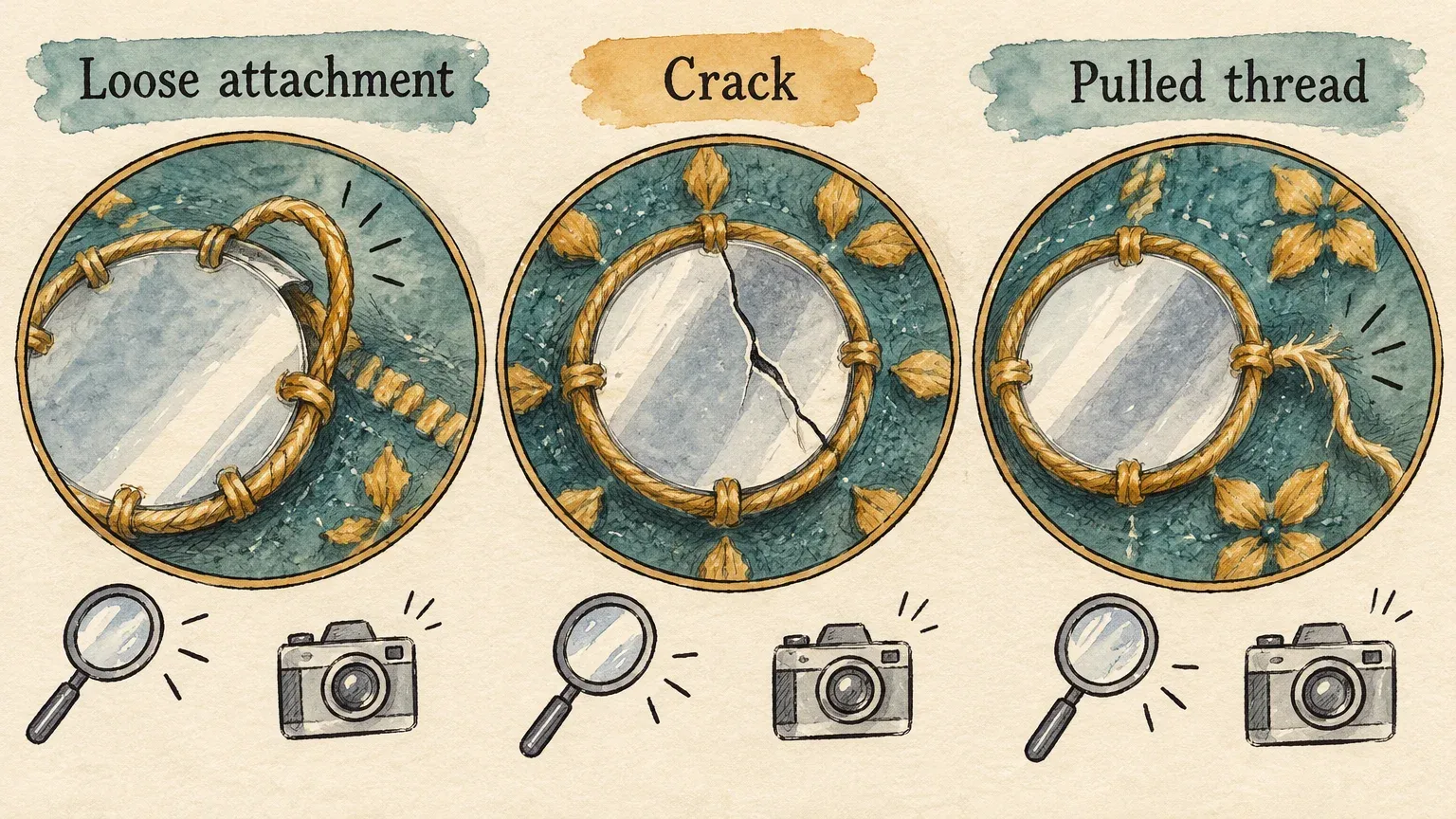
| What you notice | What to stop | How to limit handling | Photo to send |
|---|---|---|---|
| Loose attachment or lifted edge | Stop wearing and cleaning | Support the area; avoid flexing it | Close-up plus wider location view |
| Cracked mirror | Stop wearing, pressing and cleaning | Do not touch the crack; keep it away from skin | Photo without manipulating the damage |
| Pulled surrounding thread | Do not tug, trim or stitch it back | Prevent further snagging | Thread and adjacent attachment together |
Send the maker a full-garment photo, damage close-up, care-label photo and product identification. Explain what happened and any treatment already attempted. Have the damage assessed before further treatment, rather than attempting repairs with household glue, replacement mirrors or DIY stitching.
3. Reduce contact while dressing and wearing
Keep accessories and handling pressure away from decorated areas. Let lotions and antiperspirants dry before dressing, as the Drycleaning & Laundry Institute advises, because personal-care products can affect fabrics and dyes.

- Check whether jewellery, bag straps or fastenings catch or rub against decoration.
- Move the accessory or choose an alternative if contact repeats.
- Support the garment while dressing and removing it, rather than pulling on embellished areas.
Pay attention to where the decoration sits, whether you are wearing a jacket, blouse, skirt or jumpsuit.
4. Choose the cleaning route for the whole garment
Clean at home only when the complete garment’s instructions permit it and its attachments are intact. Missing labels increase cleaning risk, notes DLI’s care-label guidance.
| Label and condition | Whole-garment checks | Next action |
|---|---|---|
| A cleaning method is permitted; garment intact | Check restrictions for lining, structure and decoration | Follow that method exactly, including any machine-washing restrictions |
| Professional cleaning specified | Share the label and identify embellishments | Use a specialist experienced with embellished clothing |
| Instructions missing or unclear | Identify the garment and available care information | Pause treatment and request complete instructions |
| Attachment or mirror damaged | Document damage without manipulating it | Follow the damage-handling steps before cleaning |
Does turning it inside out or using a mesh bag make it washable? No. Neither overrides the care label, and a successful patch test checks only a limited area. The American Cleaning Institute explains that washing can harm trims or cause dyes to run.
Professional cleaning is commonly recommended for delicate or heavily embellished clothing, but the cleaner still needs to assess the garment. DLI’s bead-and-sequin guidance stresses testing those decorations before cleaning. Ask how the cleaner will assess your garment’s reflective elements and attachments.
Does denim mean machine washable? No. Our denim mirror-work jumpsuit uses 5 oz cotton denim with cotton lining, yet specifies dry clean only. Our denim top and dhoti set also lists cotton lining and dry clean only.
5. Handle stains without improvising a cleaning recipe
For makeup, food, oil or perspiration marks, record the location, likely cause, when it happened and any treatment already used. Seek advice promptly: DLI’s stain guidance recommends taking spills to the cleaner as soon as possible and explaining what was spilled.
Do not rub. The American Cleaning Institute warns that rubbing spreads stains and may damage fabric. For dry-clean-only pieces, give the specialist your stain notes and leave treatment to them. Get garment-specific instructions before spot cleaning or cleaning a mirror surface.
6. Check drying and heat instructions separately
Read the drying and heat-care symbols separately, then follow each instruction for the garment. Permission to wash covers washing only; clarify any unclear drying, ironing or steaming symbol before treatment.
Can I iron or steam mirror work? Only if the garment’s care instructions permit it, and only by the specified method. GINETEX’s care-symbol guidance says to select the maximum ironing temperature from the care label.
- Where washing is permitted, follow its accompanying drying instructions.
- Keep treatment gentle: avoid wringing, pressure on mirrors and direct ironing over decoration, even through a pressing cloth.
7. Store with support, separation and room
Store only when the whole garment, including lining and decorated areas, is fully dry, following the American Cleaning Institute’s laundry advice. Choose a cool, dark, dry, well-ventilated space, as its seasonal storage guidance recommends.
Should you fold, roll or hang it? Use the method specified in the garment’s storage instructions. Heavy embellishment needs support to prevent distortion; structured jackets also need their shape protected. Let the garment’s weight, structure and decoration layout guide how you place it.
- Use suitable breathable covers and smooth material between layers to reduce snagging and rubbing.
- Leave room around decorated areas and keep weight off mirrors.
- Position any folds clear of decoration.
- During monsoon or humid weather, check the garment and storage space for dampness. Resolve moisture before closing it away again.
Your pre-wear and post-wear checklist
- Before wear: check the label and attachments, let personal-care products dry, check accessories and dress without pulling decoration.
- After wear: support and inspect, photograph marks or damage, follow the label’s cleaning instructions and store fully dry with suitable support.
For help deciding what to do before cleaning other embellished pieces, see our advice on washing embroidered clothes safely.