

Ajrakh is known for structured repeats, as described by Khamir’s Ajrakh overview. The 2 prominent Kalamkari traditions offer pen-drawn narratives in Srikalahasti work and block-printed floral arrangements in Machilipatnam/Pedana work, as distinguished by the Crafts Council of Andhra Pradesh and the Development Commissioner (Handicrafts). Your Ajrakh vs Kalamkari choice comes down to design preference, not a hierarchy of craftsmanship. Kalamkari includes both painted and printed work.
Ajrakh vs Kalamkari at a glance
The main difference is the combination of process and composition, not simply whether a block is used. Ajrakh has historical connections with Sindh and Indian centres in Kachchh and Barmer, as described by Dr. Babasaheb Ambedkar Open University. The prominent Kalamkari centres below are in Andhra Pradesh.
| Compare | Ajrakh | Srikalahasti Kalamkari | Machilipatnam/Pedana Kalamkari |
|---|---|---|---|
| Regional context | Sindh connections; Kachchh, Gujarat, and Barmer, Rajasthan | Srikalahasti, Andhra Pradesh | Machilipatnam and Pedana, Andhra Pradesh |
| Main tool | Carved wooden blocks | Pen used to draw outlines | Carved wooden blocks |
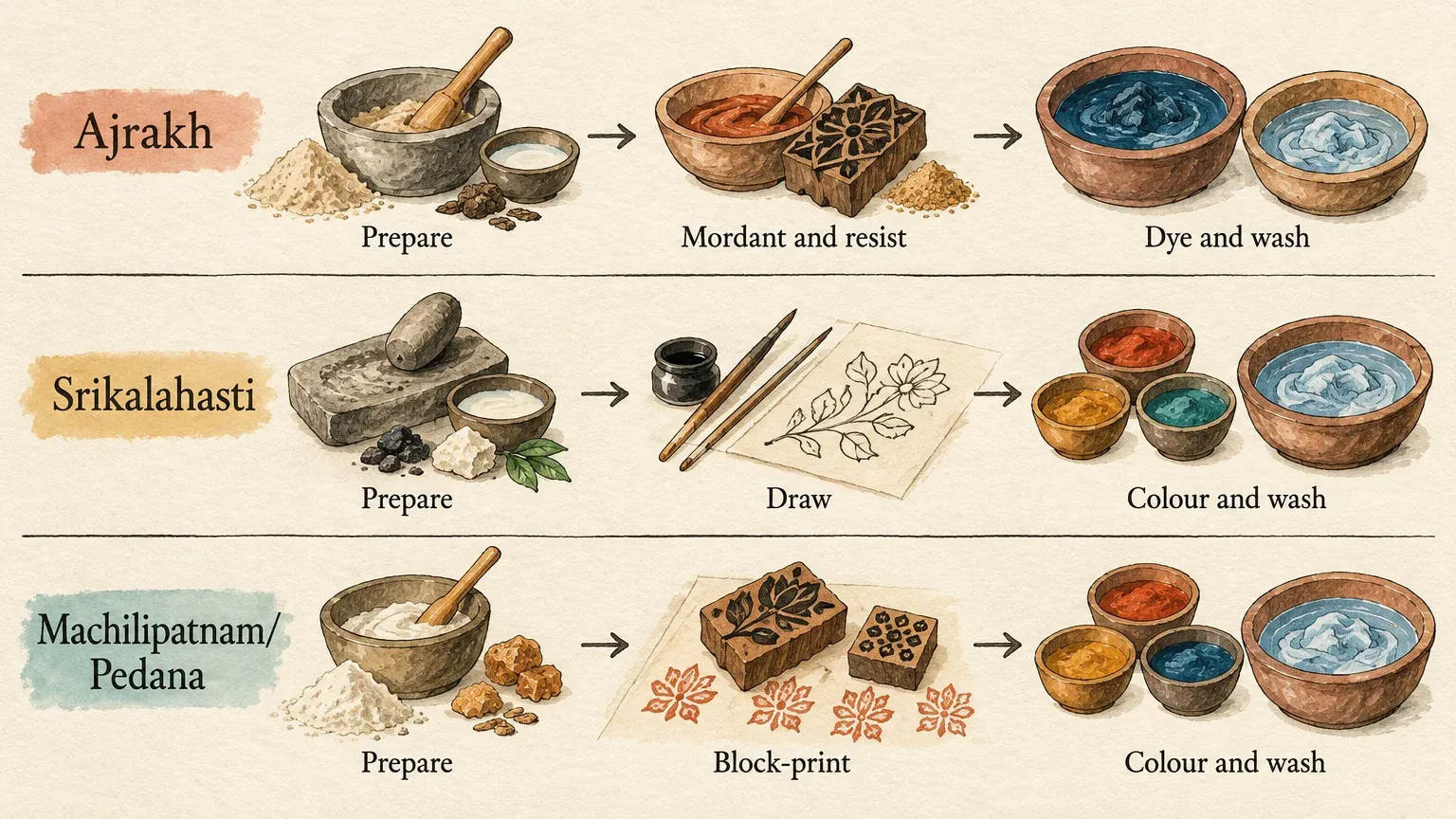
| Broad process | Cloth preparation, mordants, resist printing, dyeing and washing | Cloth preparation, drawing, colouring and washing | Cloth preparation, block printing, mordants, colouring and washing |
| Common compositions | Geometrically organised repeated fields | Narrative scenes and figurative compositions | Floral trellises, repeated arrangements and geometric borders |
| Visual clues | Interlocking geometry and star-like arrangements | Figures arranged within a larger story | Recurring floral units within an organised repeat |
| Evidence to request | Resist-and-mordant process details and printer credit | Confirmation of pen drawing and artist credit | Confirmation of wooden-block printing and workshop credit |
If structured repeats appeal to you, our contemporary Ajrakh clothing offers a way to explore the craft beyond a saree or dupatta.
Different tools, layered processes and regional histories
Ajrakh: layered resist-and-mordant block printing
Ajrakh builds its recognisable patterns through layered printing. The process involves preparatory washing, mordant application, resist printing, de-gumming and dyeing, according to Global InCH’s process account. A mordant helps establish colour on the cloth; a resist protects selected areas from colour.
These coordinated steps produce the repeated design. In Rajasthan, Barmer is a key centre for Ajrakh.
Srikalahasti: drawing with a pen
In Srikalahasti Kalamkari, artists use a pen to draw the composition’s outlines before filling it with colour, according to Impart’s Kalamkari account.
Its subjects include stories from the Puranas, Ramayana and Mahabharata, according to the Andhra Pradesh handlooms department. Painted Kalamkari cloth also has a temple history, discussed in Intellect’s temple-cloth study.
Machilipatnam and Pedana: printing with wooden blocks
Machilipatnam/Pedana Kalamkari and Ajrakh both use wooden blocks; their broader processes and compositions help distinguish them. Cloth is washed, dried and treated with mordants to obtain colours, as explained by Krishna District’s process account.
Both Kalamkari traditions can involve substantial preparation, colouring and washing. Consider the full process when judging effort and quality. Printing decorates a textile’s surface; embroidery adds stitched work, a distinction explained in our Indian embroidery types article.
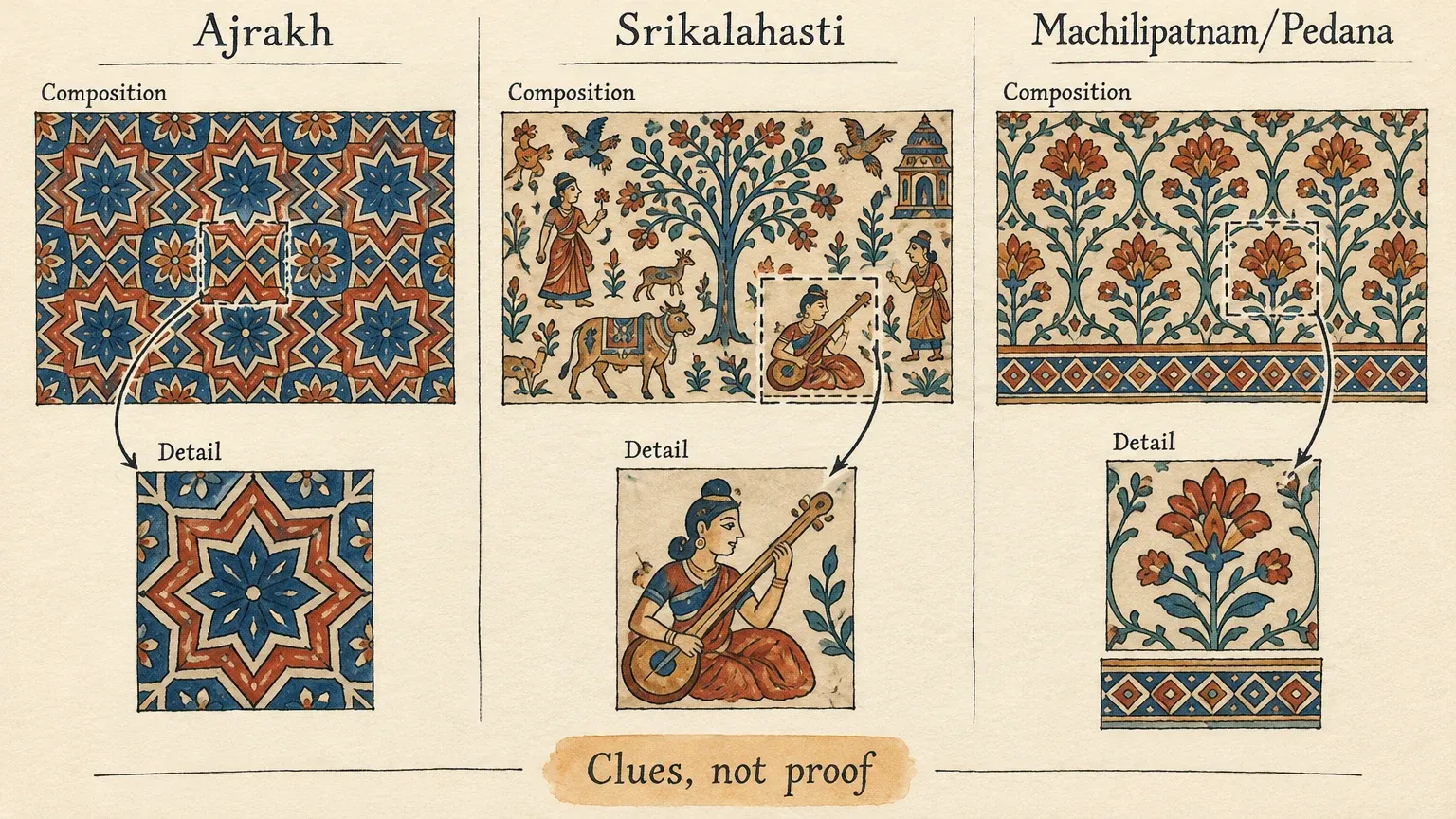
Read the composition, then check the evidence
Start with the overall composition, then examine the details.
- Ajrakh: follow how geometric units connect across the fabric. Look closely at the repeat within the larger star-like arrangement.
- Srikalahasti: look for figures, scenes and relationships across a narrative composition. Freehand Kalamkari hangings include work by Sankaraiah from Srikalahasti, featured in the University of Zurich exhibition.
- Machilipatnam/Pedana: follow the recurring floral unit and its relationship with borders. One flower tells you less than the complete arrangement.
Flowers, geometry and borders overlap across traditions, so a single motif is not enough to identify the craft.
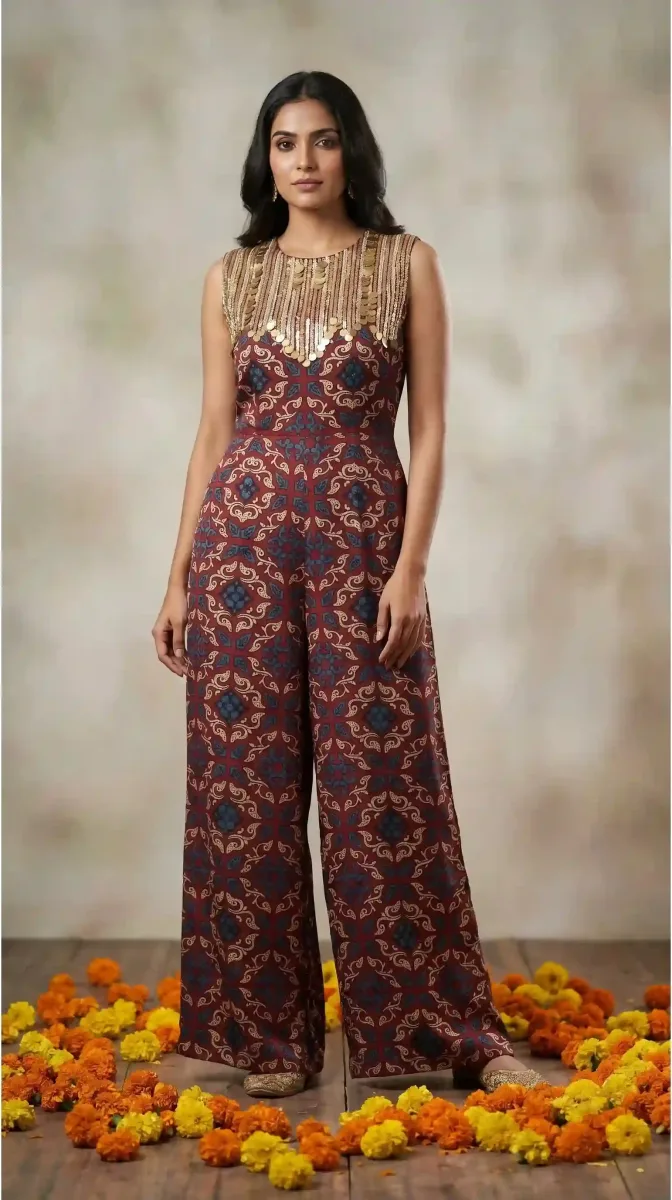
On a finished garment, inspect how the print sits across the body and seams. Our Madder Ajrakh jumpsuit credits Khatri Harun for its Ajrakh work.
A characteristic Ajrakh palette combines indigo, madder red, black and white, according to Khamir’s Ajrakh overview. Indigo is available in both natural and synthetic forms, as explained in Khamir’s account of adaptations. Colour, symmetry, line variation, block joins and small irregularities are clues, not proof of hand production, provenance or dye chemistry. Give more weight to product-specific maker, workshop and process information.
What should a seller disclose before you buy?
A seller should provide the technique, maker or workshop, production location, fabric composition, dyes used and care instructions for the finished garment. Ask the same questions across listings to make a useful comparison.
| Ask about | Ajrakh | Srikalahasti Kalamkari | Machilipatnam/Pedana Kalamkari |
|---|---|---|---|
| Technique | Is this resist-and-mordant hand-block printing? | Were the outlines drawn with a pen? | Was the cloth printed with wooden blocks? |
| Maker and place | Who printed it, and where? | Who drew and coloured it, and where? | Which printer or workshop made it, and where? |
| Fabric | What are the fibres and any blend proportions? | What are the fibres and any blend proportions? | What are the fibres and any blend proportions? |
| Dyes | Which dyes were used on this textile? | Which dyes were used on this textile? | Which dyes were used on this textile? |
| Finished-garment care | What does the care label require? | What does the care label require? | What does the care label require? |
Distinguish the textile maker’s work from garment construction: ask who stitched or embroidered the piece as well as who printed or drew the cloth. Confirm fabric weight and whether the textile is handloom-woven rather than inferring either from the craft name.
Commercially produced screen-printed versions of Ajrakh also exist, so ask whether the textile is hand-block printed, as noted in Impart’s Ajrakh account. For Kalamkari, establish whether the work is pen-drawn or block-printed.
Choose the garment as well as the craft
Scale, placement and fabric feel
Consider how the composition works when worn, not just when the textile is laid flat.
- Saree: inspect the main field, border and pallu together. Decide whether you prefer a continuous repeat or a composition concentrated in particular areas.
- Dupatta: consider what remains visible when it is folded or draped. A large narrative scene may read differently from a small repeating floral unit.
- Contemporary outfit: check how motifs meet seams, pockets and panels. Cutting can interrupt both narrative scenes and geometric repeats.
Fabric composition, weight, lining and construction influence feel and drape independently of the print name. Request these details if the listing leaves them unclear.
A product description decoded
Our Madder Ajrakh Modal Silk Jumpsuit with Embroidery is ₹7,950 inclusive of taxes. We credit Khatri Harun for Ajrakh from Dhamadka / Ajrakhpur, Gujarat, and list 37–40 artisan hours.
Each part of the name tells you something different: Ajrakh names the textile craft; Modal Silk is the listed fabric; jumpsuit describes the silhouette; and embroidery is additional stitched embellishment. Ask about the dyes independently of the colour name.
This garment is made to order in 4–5 weeks and is dry clean only. Wash either Ajrakh or Kalamkari at home only when the finished garment’s instructions permit it. GINETEX’s care guidance bases treatment on the most care-sensitive component, which may include embroidery, lining or trims.
Ajrakh pricing can reflect labour-intensive preparation and printing, alongside fabric, construction and embellishment. Compare like-for-like garments before judging value, and assess durability and care for the whole garment rather than the printed cloth alone.
Choose Ajrakh if / choose Kalamkari if
- Choose Ajrakh if you enjoy characteristic structured repeats and layered block-printing traditions.
- Choose Srikalahasti Kalamkari if pen-drawn narratives and figurative compositions appeal to you.
- Choose Machilipatnam/Pedana Kalamkari if you prefer block-printed floral arrangements and repeated fields.
Let that preference guide your shortlist, then check the fabric, placement, provenance and care requirements. Our Ajrakh collection offers contemporary options, while our Artisan Stories introduce embroidery makers. For a closer look at how the textile is made, explore our Ajrakh printing process article.