

Store silk sarees clean and completely dry, individually wrapped in clean, prewashed cotton or muslin, in a cool, dry, dark wardrobe. Support broad folds for heavy zari or heavily embroidered pieces, following the Canadian Conservation Institute’s guidance. Plan to review the folds every 3–6 months. Asianet Newsable recommends airing stored sarees indoors in shade every 3–6 months. Inspect sooner during humid periods.
Start with a clean working surface, clean prewashed cotton or muslin, and suitable fold padding if needed. Let the care label and the garment’s construction determine how you clean, fold and support it.
1–2. Read the label and inspect after wear
Step 1: read the care label, then examine the fabric, decoration and structure before deciding how to pack:
| Construction | Main storage concern | Practical approach |
|---|---|---|
| Plain silk | Persistent sharp creases | Use broad, supported folds. |
| Metallic tissue | Compression and distortion | Preserve its existing structure; avoid tight bundles. |
| Woven zari | Unsupported weight and rubbing | Support heavy sections and separate borders from vulnerable silk. |
| Raised embroidery | Snagging and crushed motifs | Separate contact surfaces and keep weight off the work. |
| Tailored blazer | Shoulder strain or loss of shape | Choose supported hanging or flat storage according to condition. |
Step 2: inspect the neckline, areas that touch the underarms, waist, hem and pallu for perspiration, food, cosmetics, loose threads and existing marks. The Drycleaning & Laundry Institute explains that perspiration and antiperspirant salts can weaken silk fibres and change their colour.
Not every silk saree needs dry cleaning before storage. Decide from its condition and care label. If a dry-clean-only piece needs cleaning, use a cleaner experienced with silk and embellishments.
Complete any washing and ironing before packing, and wrap the saree only when it is completely dry.
3–4. Choose a dry wardrobe space and breathable wrapping
Step 3: choose a cool, dry, dark shelf with stable conditions and enough room to lift out each bundle without dragging it.
- Avoid damp corners, direct sunlight, heaters and hot cupboard surfaces.
- Use a clean protective lining between wrapped textiles and wood, metal or cupboard polish.
- During monsoon, check the shelf and surrounding wall for dampness before packing.
If the wardrobe is damp, move garments to a reliably dry location and address the moisture source. For persistent high humidity, the George Washington University Museum recommends considering a dehumidifier.
Step 4: use clean cotton or muslin for individual wrapping. The CCI’s textile-care guidance recommends prewashing fabrics used for packing and cushioning textiles.
| Material | Storage decision | Important condition |
|---|---|---|
| Prewashed cotton or muslin | Use as a breathable wrap | Keep it clean and completely dry. |
| Thin dry-cleaner garment bag | Remove before long-term storage | Use a suitable long-term wrap or container instead. |
| Rigid polyethylene box | Can be suitable | Use clean lining, dry contents and a dry location. |
A suitable plastic box is also an option: the Canadian Conservation Institute accepts polyethylene boxes for textile storage.
5. Fold silk sarees gently and protect decorated areas
Heavy zari and heavily embroidered sarees are best stored with supported folds: unsupported weight can strain the textile during prolonged hanging.
- Spread and support. Lay the saree on a clean surface. Support its length so heavy sections do not pull over an edge.
- Bring sections together loosely. Make broad folds that suit the available shelf and avoid decorated areas. Keep each fold softly rounded.
- Pad and separate. Support unavoidable folds with soft prewashed cotton or suitable acid-free tissue. Place a clean, soft barrier between rough decoration and adjacent silk.
- Wrap loosely. Enclose the folded saree in cotton or muslin without tightening the wrap.
CCI recommends padding folds and periodically changing them to prevent permanent creasing.
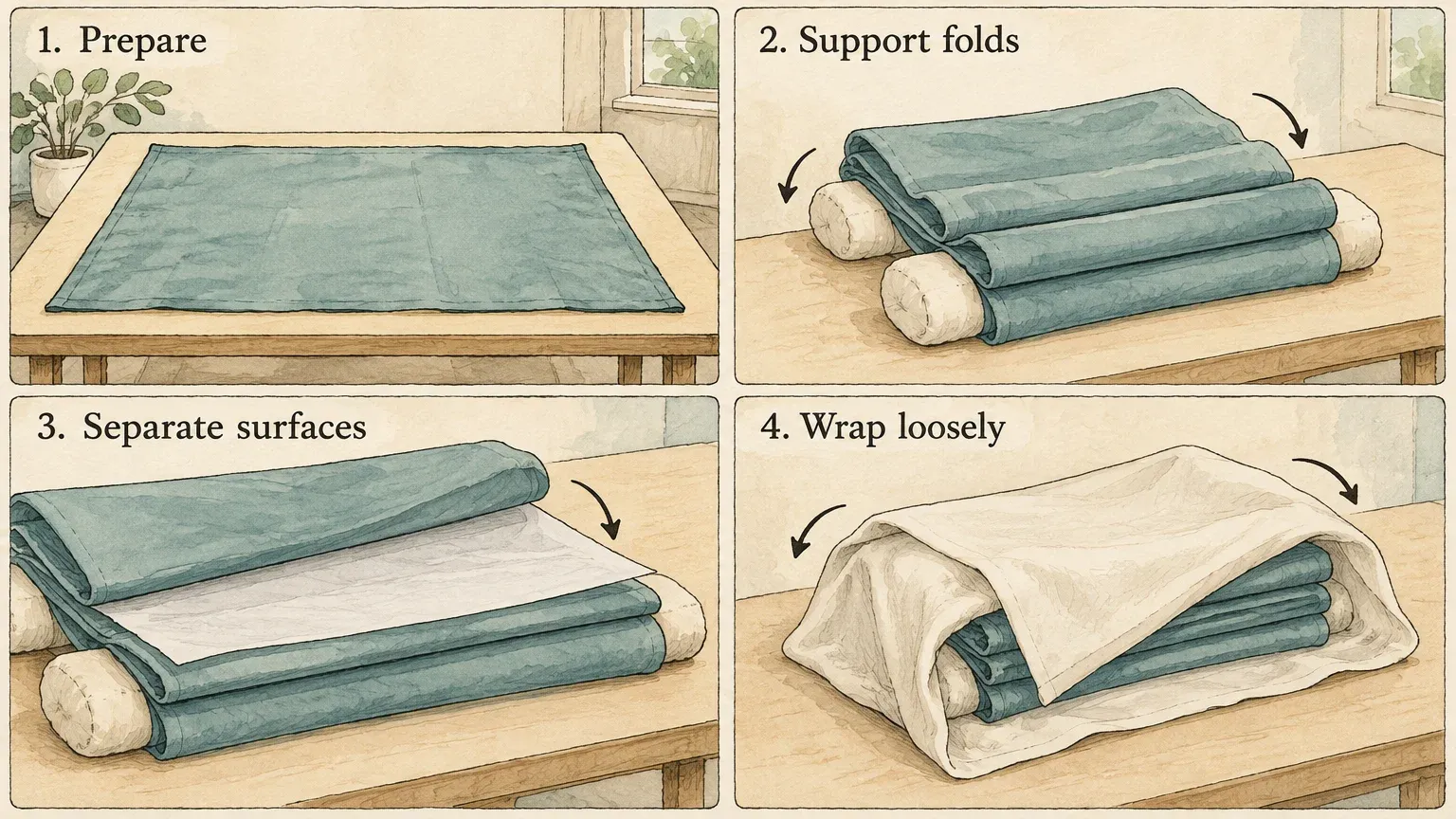
Fold woven zari borders inward if this reduces exposed contact without creating a tight, bulky fold. Leave space around raised embroidery, with a soft barrier shielding the work. Metallic tissue also needs room to preserve its surface structure.
Keep zari and embroidery away from moisture, friction, direct perfume and other chemicals. Do not polish or dry-rub tarnished zari.
Common mistakes: folding through raised motifs, pressing sharp creases, hanging heavy decoration and placing a heavy stack over embroidery.
6. Store matching pieces nearby, not compressed together
Wrap coordinated pieces individually where practical and keep them nearby, with protective barriers between them. Leave room to lift each piece gently, keeping fastenings and embroidery clear of silk. National Museums Scotland’s handling advice highlights how fastenings, beads and sequins can catch and damage textiles.

Example: a saree, blouse and matching blazer
Our SHYAAM saree and blazer set is a handloom tissue silk blouse, saree and blazer ensemble with Zardosi hand embroidery by Shambu Adhikary and 180–198 artisan hours of work. Its care instruction is dry clean only. Give each component the support its construction needs:
- Saree: support broad folds while protecting the tissue and decoration.
- Blouse: keep fastenings and raised work away from neighbouring fabric.
- Blazer: assess its structure, shoulders, decoration and condition before choosing support.
A sturdy tailored blazer in good condition may suit a properly fitted padded hanger, according to National Park Service guidance. Fragile fabric, heavy decoration or vulnerable shoulders may require supported flat storage instead.
Avoid compressing the entire outfit into one package. The CCI’s flat-storage guidance warns that accumulated stacking weight can crush textiles underneath.
7. Schedule inspections and act on changes
Inspect more often than you refold
Inspect for insects and other problems once a month, as recommended by Icon’s costume and textiles guidance. Check sooner if dampness appears during humid weather. Keep checks brief and handling minimal for fragile sarees.
Review the folds when you air the saree. Gently vary their positions only if the textile can tolerate handling. Choose a clean, dry, shaded indoor space during monsoon, and repack only when the saree is completely dry.
Prevent pests through clean garments, clean shelves and regular inspection. Look for insects, larvae, shed skins, debris and new holes. Avoid adding powders, oils or scented remedies to the wrapping.
Troubleshooting: repack or seek specialist help?
Repack only when the saree is dry and sound. Investigate unexplained changes before returning it to the wardrobe, and seek specialist help for stains, suspected mould, infestation or weakened fabric.
| What you find | What to do |
|---|---|
| Sound fabric, but crowded packing | Use a clean barrier, gentler folds and more space. |
| Persistent mustiness or cupboard dampness | Check the environment, relocate sound pieces and seek experienced advice if the smell persists. |
| Stains or unexplained marks | Consult a cleaner experienced with silk and embellishments; avoid home spot treatments. |
| Suspected mould or insect infestation | Separate the affected item, use clean polyethylene containment and obtain specialist advice. |
| Tarnish | Seek specialist advice rather than polishing or rubbing. |
| Weakened folds or loose embroidery | Reduce handling; use a textile conservator for weakened fabric and a suitable repair specialist for loose work. |
For mould or infestation, the CCI’s isolation guidance recommends sealed, clean polyethylene bags away from other textiles. Use these bags for temporary isolation. Consult a textile conservator for suspected mould or fragile heirlooms; do not attempt DIY mould removal.
Frequently asked questions
Is it better to hang or fold silk sarees?
Fold heavy zari and heavily embroidered sarees with broad, supported folds to reduce strain from unsupported weight. Plain silk can also use this routine. Choose support according to the fabric, decoration and condition.
Can silk sarees be stored in a plastic box?
Yes, a suitable rigid polyethylene box can be used with clean lining, completely dry contents and a dry storage location. Remove thin dry-cleaner garment bags before long-term storage.
How often should silk sarees be checked and refolded?
Inspect monthly for insects, dampness and other changes, with earlier checks if dampness appears during humid weather. Plan a 3–6-month airing and fold review, varying folds gently only when the saree tolerates handling.
Can I store a saree and its embroidered blazer together?
Keep them nearby, with individual wraps or protective barriers preventing fastenings and embroidery from rubbing against silk. Support the saree’s folds and assess the blazer separately. A sturdy tailored blazer in good condition may suit a fitted padded hanger; fragile or heavily decorated pieces may need supported flat storage.
Can careful storage guarantee that a silk saree will last for decades?
No. Previous wear, cleaning, construction and existing damage all affect how a saree ages. Dry conditions, supported folds and minimal handling reduce avoidable damage but cannot reverse deterioration.
Can I use the same storage routine for a silk dress?
Yes, start with the care label, dry conditions and clean protective barriers, but adapt the support to the dress. A sturdy, structured dress in good condition may suit a fitted padded hanger, while fragile or heavily decorated pieces may need supported flat storage. Keep fastenings and embellishments from snagging adjacent fabric.
How to store silk sarees: your printable checklist
After wearing
- ☐ Inspect for residues, marks and loose work.
- ☐ Arrange label-appropriate cleaning when needed.
- ☐ Confirm the garment is completely dry.
Before long-term storage
- ☐ Choose a dry, dark location and protect cupboard surfaces.
- ☐ Use a clean, prewashed cotton or muslin wrap.
- ☐ Support folds and separate decorated surfaces.
- ☐ Wrap matching pieces individually and leave retrieval space.
Periodic inspection
- ☐ Inspect monthly for dampness, pests and condition changes; check earlier if dampness appears during humid weather.
- ☐ Schedule a 3–6-month airing and fold review in clean, dry, shaded conditions.
- ☐ Vary folds gently only when the textile tolerates handling.
- ☐ Record the inspection date, next review date and any existing marks or loose embroidery for comparison.
Dry conditions, clean barriers, supported folds and enough space matter more than tightly packing a complete set. Before cleaning, learn how to wash embroidered clothes safely.