

Slow fashion means a more considered approach to making, buying and using clothes: fewer purchases, quality, longevity and attention to production, as Kate Fletcher explains in The Ecologist. It has no fixed price or minimum number of wears. Our made-to-order policy, for example, specifies 4–5 weeks before dispatch, with transit additional. Consider handmade work, price and production method alongside fit, materials and care needs. For wedding and festive shopping, choose clothing that fits, arrives on time and earns repeat wear.
Slow fashion versus fast, sustainable and ethical fashion
Slow fashion prioritises considered production and longer use over rapid turnover and frequent replacement. UNEP’s fast-fashion overview identifies quick turnover, high volume and cheap prices as features of fast fashion. These are typical differences; look at what each brand tells you about its production.
| Aspect | Fast fashion | Slow fashion |
|---|---|---|
| Production pace | Rapid, high-volume turnover | More deliberate production, sometimes small-batch or made-to-order |
| Trend cycles | Frequent newness | Designs chosen for longer relevance |
| Purchasing habits | Frequent, trend-led buying | Fewer, considered purchases |
| Garment use | Earlier replacement encouraged | Care, repair and repeat wear encouraged |
| Transparency | Disclosure of makers, locations and material sourcing depends on the brand | Maker, location and material-sourcing disclosures guide considered purchases |
Slow fashion concerns pace, consumption and longevity. Sustainable fashion focuses on environmental impacts. Ethical fashion concerns the treatment of people and animals. These priorities overlap, but none of these labels is, by itself, a certification.
Buying less and keeping clothes in use aims to reduce demand for new resources and avoid premature disposal. Fashion Revolution’s guidance encourages lower consumption, quality and better care. Look for information about a garment’s production and use when assessing its environmental claims.
India’s CCPA greenwashing guidelines require credible evidence for environmental claims. A craft name or handmade label answers a different question from a claim about environmental impact.
Craft provenance and worker welfare are different questions
Local identifies where production happens; artisanal refers to craft-based skills and methods; fair-trade claims concern trading and labour standards. Check which fair-trade scheme applies and what it covers.
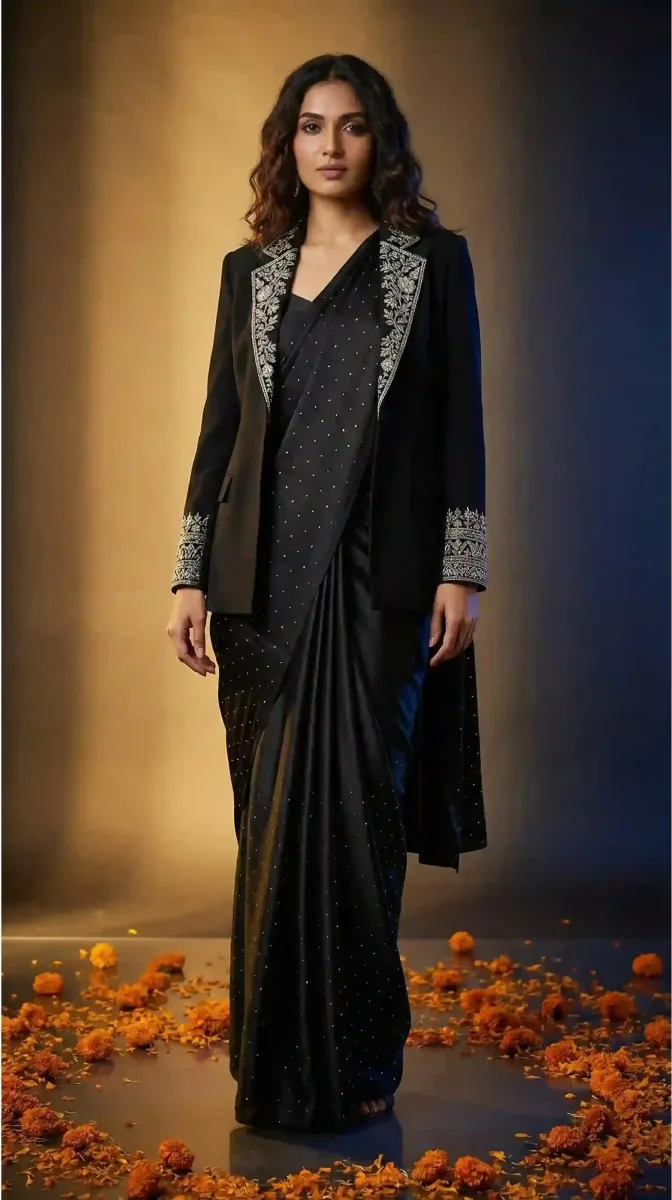
Ask for an accurate craft name, such as Zardosi, mirror work or Lambani embroidery, and identify which garment component carries it. Our KAAL Zardosi saree-blazer set names lead artisan Shambu Adhikary in Bhopal, lists 70–77 artisan hours and specifies dry cleaning only.
For worker welfare, ask:
- Who makes the garment, and is work subcontracted?
- How are artisans paid, including for revisions?
- What safety measures and worker protections apply?
- What evidence supports any labour certification claim?
Look for written details of pay arrangements and workplace protections alongside maker names and handwork hours. This applies equally to handcrafted, local and charitable labels.
The International Labour Organization’s garment-worker overview describes informal garment workers as typically lacking access to social security, labour-law coverage, healthcare and minimum-wage protections. Knowing the craft’s origin does not answer these worker-welfare questions.
Read fabric claims beyond “natural” and “eco-friendly”
Ask for the fibre percentages in the outer fabric, lining and trims, then check sourcing, processing, comfort and upkeep.
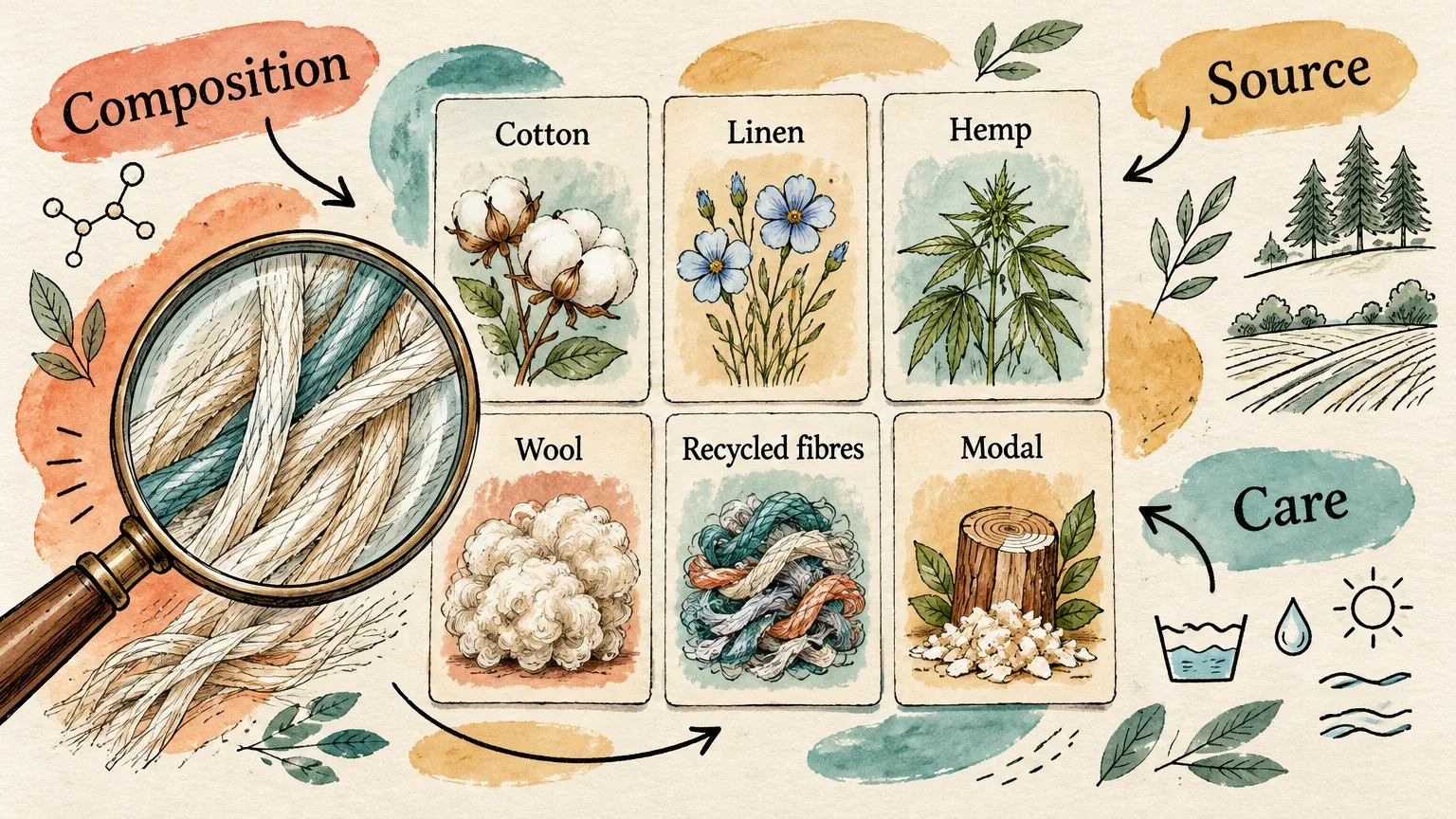
| Material | Information to request | Practical checks |
|---|---|---|
| Cotton | Origin, blends and evidence for organic claims | Dyeing, shrinkage and fabric construction |
| Linen | Fibre percentage, sourcing and finishing | Creasing, comfort and seam quality |
| Hemp | Fibre percentage, processing and blends | Handle, movement and care requirements |
| Wool | Sourcing and animal-welfare information | Climate suitability, storage and cleaning |
| Recycled fibres | Recycled percentage, source and traceability evidence | Durability, blends and repair options |
| Modal | Exact composition, cellulose source and processing | Care, construction and any actual silk content |
Textile Exchange defines modal as a regenerated cellulosic fibre and a variation of rayon or viscose. For a name such as “modal silk”, ask for the fibre percentages to establish its actual silk content.
Textile Exchange’s cellulosic fibre guidance links environmental impacts substantially to how source materials are produced. Its Future of Synthetics report also warns that replacing synthetics with land-based materials at current production volumes could put pressure on natural ecosystems.
Ask what an environmental claim covers: a fibre, a processing stage or the whole garment. Natural, recycled and blended materials all need to be assessed in the context of the garment.
What should you confirm before ordering made-to-measure occasionwear?
Confirm production and transit timing, measurements, alteration conditions, cancellation terms and whether the garment can arrive before your event. Do this before paying. Made-to-order means production begins after ordering and can use standard sizes; made-to-measure means construction uses your measurements. A garment can be both.
For help with measurements, our UMRAO fit information offers measurement review and a complimentary WhatsApp fit consultation.
- Check measurements: confirm the measuring method, desired ease and fit preferences, including sitting and arm movement.
- Understand remedies: our measurement errors qualify for a remake; incorrect customer measurements receive one complimentary alteration. Agree shipping or local alteration arrangements with us.
- Check cancellation and returns: cancellation requests are permitted within 24 hours only before cutting begins. Ask separately about applicable return terms.
- Confirm arrival: request transit information for your destination and confirm that the garment can arrive before your event. Check the arrival date, not just the dispatch date.
Example: working backwards from a wedding
Assume your wedding is 8 weeks away, transit takes 1 week and you allow 1 week for try-on and alterations. Allow 5 weeks for production: 5 weeks + 1 week transit + 1 week for fit = 7 weeks. That leaves 8 weeks − 7 weeks = 1 week spare. Confirm transit and alteration timings with the team before ordering.
Quality, care and repeat wear: making clothes worth keeping
Quality means secure seams, sound finishing, securely attached embroidery, reliable closures, suitable lining and comfortable movement. Check whether repairs and alterations are practical. Look beyond price and styling: the garment must suit your climate, events and wardrobe.
Start with clothes you own. Repairing, altering, renting occasionwear and buying vintage are among UNEP’s circular clothing suggestions. Borrowing or buying second-hand may also meet your need without a new purchase.
For repeat wear, pair a festive blazer with existing trousers, a saree with another suitable blouse, or a blouse with a skirt you own. Choose combinations you would genuinely wear.
Follow the garment-specific care label, including dry-clean-only instructions. Ask the maker or cleaner about embroidery handling, suitable storage and repair support before buying.
Example: cost per wear for a ₹12,000 garment
Assume a ₹12,000 purchase, excluding care and alteration costs. Compare two outcomes:
- Repeated use: ₹12,000 ÷ 12 wears = ₹1,000 per wear.
- Infrequent use: ₹12,000 ÷ 3 wears = ₹4,000 per wear.
Slow fashion need not be expensive: existing clothes cost nothing new to buy. Work out cost per wear using occasions you realistically expect to attend. It measures personal financial value, but the upfront price still needs to fit your budget.
Your seven-part shopping checklist
Copy these questions into your shopping notes and record the answers before committing.
| Decision | Record | Ask |
|---|---|---|
| Wardrobe need | Occasion and existing options | Can I wear, borrow or rent? |
| Production deadline | Production, transit and cancellation terms | Is arrival confirmed? |
| Craft identification | Technique, component, maker and region | What is handmade? |
| Material composition | Fibre percentages, lining and trims | What supports sourcing claims? |
| Fit and alterations | Measurement review and written remedies | Who handles errors and logistics? |
| Care and repair | Care label, costs and repair options | Can embroidery be repaired? |
| Repeat wear | Specific events and outfit combinations | Will I actually wear these? |
Use the table below to distinguish what a claim tells you from what you still need to ask.
| Claim | Useful evidence | Scope and limits |
|---|---|---|
| Made-to-order | Written production policy | Production schedule; assess waste and emissions separately |
| Hand embroidery | Named technique and garment component | Craft method; fair pay needs wage information |
| Artisan-made | Maker, location and production account | Provenance; safe conditions need workplace evidence |
| Natural or recycled fabric | Composition, sourcing and claim-specific records | Fibre content; full lifecycle also includes processing and use |
| Fit support | Measurement and alteration terms | Listed remedies; confirm your measurements and fit preferences |
| Fair labour | Pay, safety and relevant certification evidence | Only workers and sites covered by the evidence |
| Care instructions | Garment-specific cleaning and storage guidance | Upkeep guidance; assess environmental claims separately |
| Planned repeat wear | Concrete occasions and wardrobe combinations | Intended use; record actual wears |
Resolve the questions that could change your purchase. If you still need handcrafted occasionwear, explore our collection and review product and fit details before ordering.