

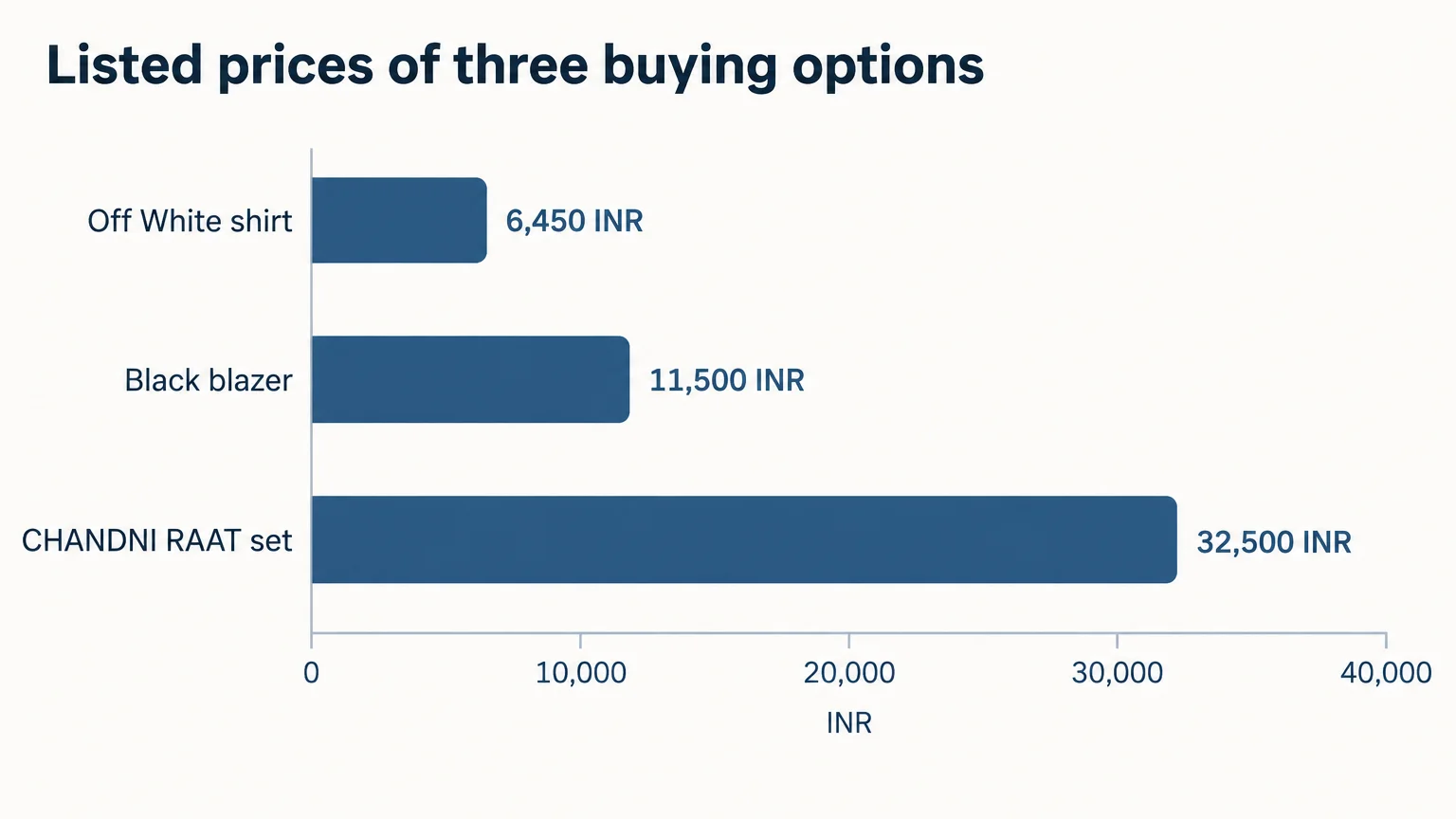
For an office Diwali party outfit, start with an embroidered shirt and formal trousers, a coordinated set or a straight kurta and trousers. Add an embroidered jacket or draped ensemble when the setting warrants it. Our Off White Zardosi Shirt costs ₹6,450. Our Black Zardosi Blazer costs ₹11,500. Our three-piece CHANDNI RAAT set costs ₹32,500. These prices include taxes. Production takes 4–5 weeks before dispatch; transit time is additional.
A lunch followed by meetings needs a different outfit from an evening celebration. Start with your working day, and remember that reusing suitable clothes is a good decision, especially when the event is close.
An office Diwali party outfit shortlist to start with
These five formulas suit different workplace expectations.
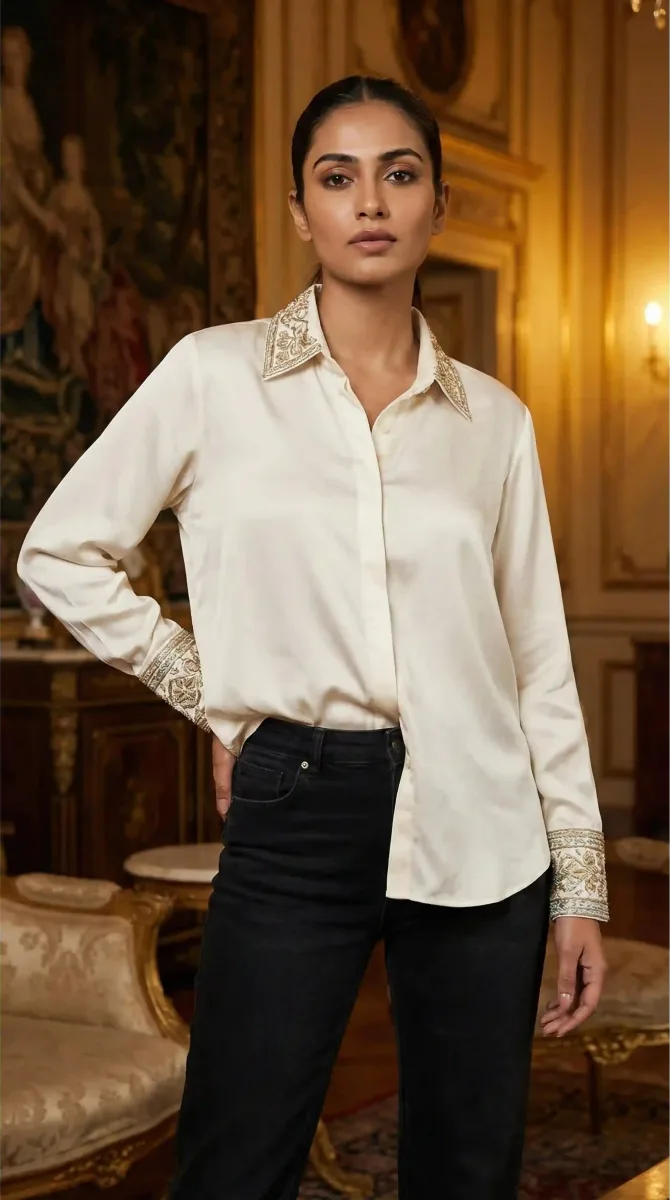
- Embroidered shirt with formal trousers: Pair an ivory embroidered shirt with existing navy or black trousers, studs, familiar flats or low block heels and a structured work bag. This is a useful starting point for lunch followed by meetings.
- Coordinated top-and-bottom set: Choose a matching outfit whose proportions work seated as well as standing. Add small earrings, comfortable office shoes and an existing neutral bag. It suits a daytime celebration or a creative workplace, subject to its dress code.
- Embroidered jacket over a work-ready base: Wear a festive jacket over a suitable top and trousers, with simple earrings, loafers or low heels and a bag with a smooth strap.
- Straight kurta and trousers: Reuse a favourite kurta with straight or cigarette trousers, earrings, familiar juttis or flats and a work tote. Colour and accessories can make a plain kurta feel festive.
- Draped ensemble or saree-blazer look: Choose this for a dressier after-hours invitation, with restrained jewellery, stable occasion shoes and a small bag.
Match the outfit to the invitation and your working day
Lunch, client-facing celebration or after-hours party
Dress for the most demanding part of the day: meetings determine a lunch outfit, client expectations determine a client-facing look, and the invitation guides an evening celebration.
| Setting | Silhouette and detail | Coverage | Footwear | Work afterwards |
|---|---|---|---|---|
| In-office lunch | Shirt, straight kurta or manageable coordinated set; restrained detail | Normal workplace standard | Full-day flats, loafers or low heels | Keep sleeves, hems and accessories task-friendly |
| Client-facing celebration | Tailored separates or a polished traditional outfit | Client-meeting standard unless explicitly changed | Polished, familiar office shoes | Choose an outfit ready for an unexpected meeting |
| After-hours party | Dressier drape, saree-blazer or embellished ensemble if invited | Event expectations and your comfort | Stable occasion shoes | Allow for commuting, stairs and seating |
Client rules can override a relaxed day. For example, Gemini Solutions’ November 2022 dress-code policy requires business formals for external client visits and meetings, even on business-casual days.
Use this garment-by-garment matrix to match each option to your working day.
| Option | Coverage and embroidery | Sitting and reaching | Commute and footwear | Return to work |
|---|---|---|---|---|
| Our Off White shirt | Work-coverage and embroidery-contact check | Keyboard clearance | Work bag; familiar flats | Lunch, then meetings |
| Our Black blazer with existing base | Coverage without the blazer | Layered seated ease | Smooth strap; loafers | Remove layer as needed |
| Coordinated top and trousers | Both pieces meet office expectations | Seated ease | Stairs; office shoes | Daytime or creative workplace |
| Our CHANDNI RAAT | Blouse, skirt and blazer separately | Seated drape | Stairs; stable occasion shoes | After-hours event |
| Straight kurta and trousers | Usual work-coverage standard | Sleeve clearance | Familiar juttis or flats | Lunch and ordinary tasks |
Read the dress code before choosing the silhouette
The invitation, employer policy and organiser’s clarification take priority over generic styling advice. Use these interpretations as starting points:
- Ethnic: Traditional clothing may be expected. Clarify whether an embroidered shirt or Indo-Western set qualifies.
- Festive: Colour, craft or embellishment may be enough; bridal dressing is not implied.
- Smart casual: Start with polished separates and add festive detail.
- Formal: Establish whether this means business formal or evening occasionwear.
Sequins, sleeveless clothing, denim and bright colours depend on the actual workplace. Akme Fintrade’s published HR policy, for instance, includes sarees, salwar kameez and Western formals for women but excludes jeans. Follow your own employer’s policy.
Choose festive detail that works while you sit, type and commute
Fabric, colour and embroidery placement
Fabric and well-placed embroidery provide festive impact. Green, maroon, navy, ivory and muted metallics are useful choices. Choose around your preferences, existing wardrobe and workplace context.
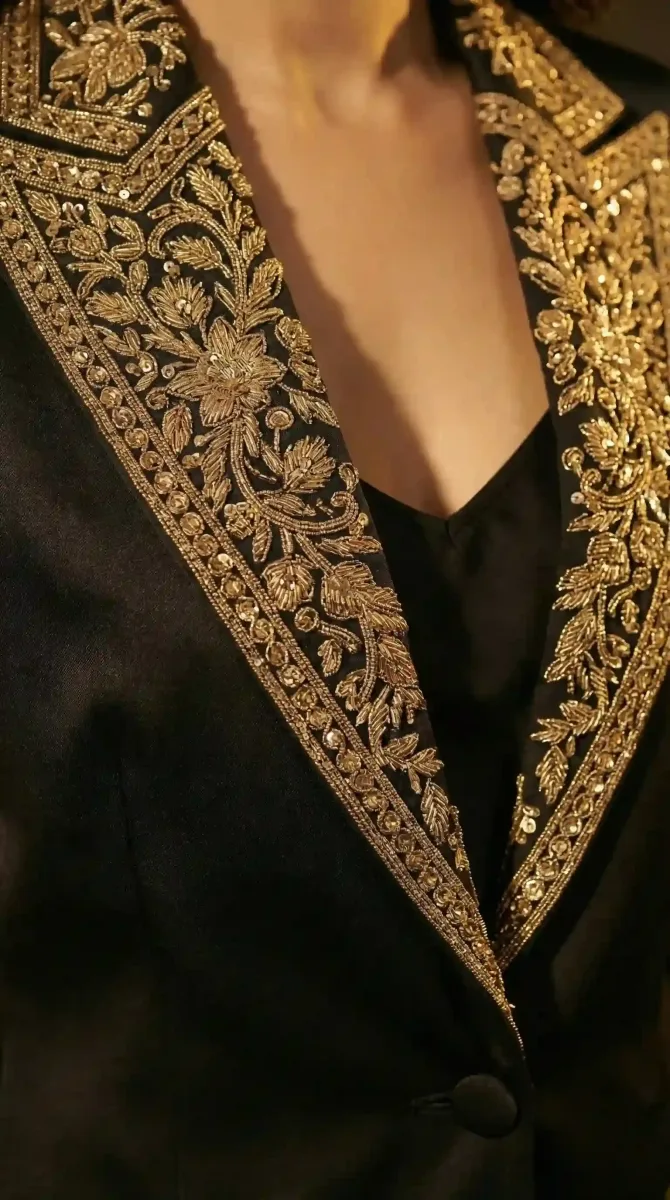
Our featured shirt and blazer use modal silk with Zardosi hand embroidery; our CHANDNI RAAT uses handloom tissue silk with Zardosi work.
Assess detail at the collar, cuffs, neckline and jacket fronts on the garment you intend to wear. Decoration near a keyboard or bag strap has different practical consequences from decoration away from contact points.
Craftmark’s Zardozi craft documentation describes metal-thread materials, sequins and sometimes beads.
The movement and removable-layer check
The National Institute of Open Schooling’s clothing-selection lesson identifies shoulders, bust, waist and length as fit checks, and recommends opening and closing fasteners.
- Sit and reach: Type, lean forward and raise your arms. Notice restriction, pulling or gaping.
- Walk: Test steps, hems and drapes with the shoes you will actually wear.
- Check contact: Notice embroidery rubbing against desk edges, cuffs, bag straps or underlying clothing.
- Remove the jacket: Wear the jacket open, then remove it. Check that the underlying outfit still meets your coverage needs.
For evening, change earrings or your bag. Switch shoes only if the replacement remains comfortable. For detailed combinations, use our Zardosi shirt styling guide.
Compare the complete outfit cost, not just the listed price
Compare each option’s complete outfit cost. If you already own suitable trousers, shoes and a bag, one new garment may be sufficient.
| Buying option | Listed price | Included clothing | Other wardrobe needs |
|---|---|---|---|
| Reuse an existing complete outfit | No new clothing purchase | Your existing garments | Use existing accessories and shoes |
| Our Off White shirt | ₹6,450, tax-inclusive | Shirt | Trousers, shoes, jewellery and bag |
| Our Black blazer | ₹11,500, tax-inclusive | Blazer | Suitable base top, trousers and accessories |
| Our CHANDNI RAAT set | ₹32,500, tax-inclusive | Blouse, draped skirt and blazer | Shoes, jewellery and bag |
Our Black blazer offers custom measurements and alteration support. For CHANDNI RAAT, confirm your event date with us before purchase; domestic shipping is free.
For a coordinated outfit, compare its stated component list and total price with what your wardrobe actually lacks. Confirm what the price includes.
Use this budget line: new garment + missing clothing + footwear or bag purchases + any alteration cost = complete outfit spend. Reusing suitable components avoids unnecessary additions.
Our shirt listing credits Shambu Adhikary in Bhopal with 30–33 artisan hours; our blazer listing records 53–58 hours. These documented making inputs explain the craft involved. Your decision should still rest on fit, repeat use and an affordable complete outfit.
Will a made-to-order outfit arrive before your office celebration?
No, an order placed on 18 October 2026 does not fit a celebration on or before Diwali under our standard 4–5-week production window; transit time is additional. Diwali falls on Sunday, 8 November 2026, according to the Director General of Audit’s calendar and U R Rao Satellite Centre’s calendar.
Worked example: ordering on 18 October 2026
Assume an order is placed on 18 October 2026 and follows the standard production window:
- Four weeks: 4 × 7 = 28 days; 18 October + 28 days = 15 November.
- Five weeks: 5 × 7 = 35 days; 18 October + 35 days = 22 November.
That puts production completion at 15–22 November, before additional transit. Dispatch means the garment leaves, not that it has arrived.
Plan backwards from your actual office celebration, which may precede Diwali. Allow for production, shipping, trying on and any alterations. For a close event, reuse a suitable outfit.
Your final purchase-or-reuse checklist
- The outfit matches the invitation, employer policy and any meetings afterwards.
- You can sit, reach, walk and commute comfortably, including without a removable jacket.
- You know which garments the price includes and which pieces you already own.
- The complete cost works, and production plus transit fits the actual event date.
If those conditions are met, buy the piece that fills a genuine wardrobe gap. Otherwise, reuse your strongest existing outfit and make a small styling change. For a future celebration with enough lead time, explore our Zardosi shirts and separates.