
Choose a kaftan-and-draped-skirt set for separate components and a flowing top. Choose a jumpsuit for an integrated top-and-trouser outfit, with particular attention to torso and lower-body fit. Our made-to-order production takes 4–5 weeks before dispatch, with shipping transit additional, under our order policy. Neither silhouette is automatically more comfortable or dressier: construction, fabric and fit determine how it feels at your celebration.
What each silhouette includes
A kaftan generally falls loosely from the shoulders, with a flowing silhouette and little waist shaping. Length, sleeves and volume vary: it can be a short top, a longer tunic or a standalone dress.
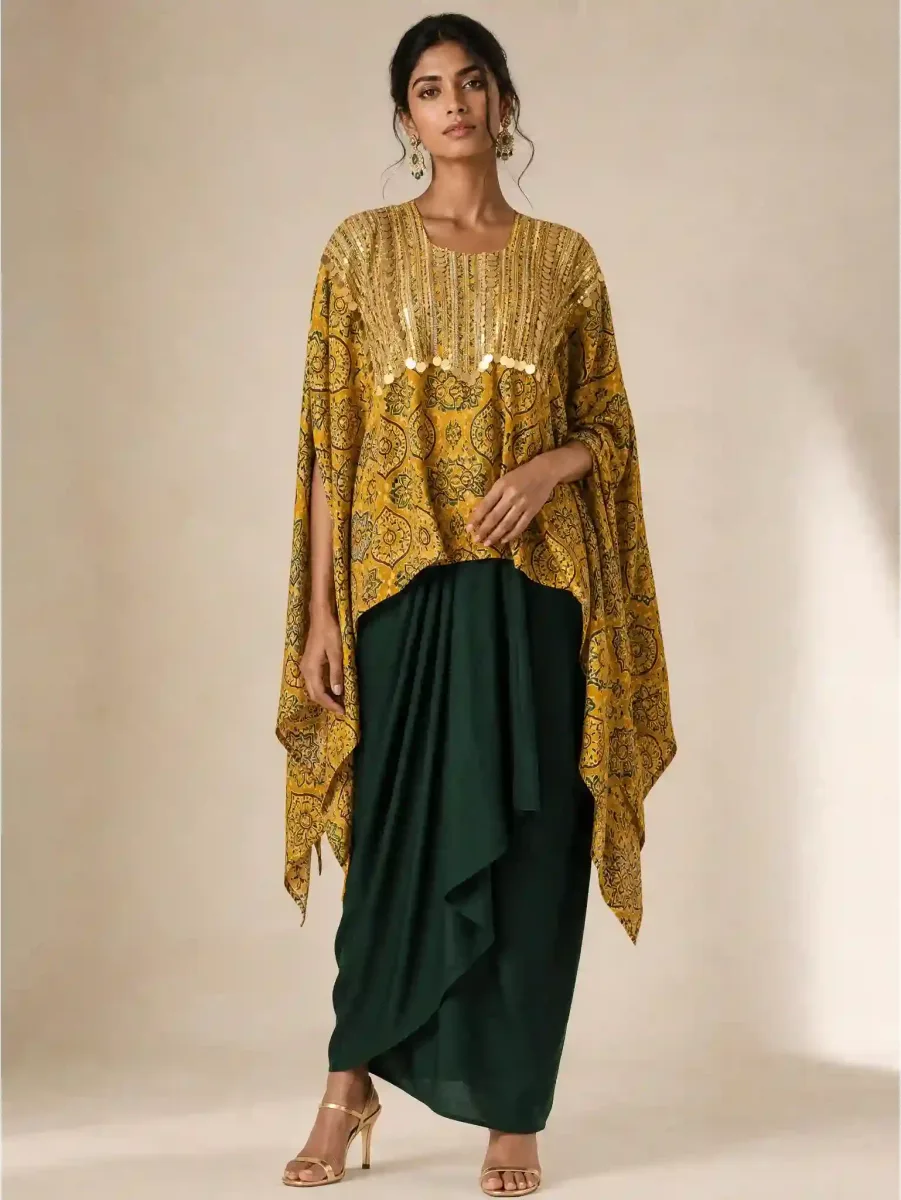
A kaftan set pairs that top with a separate bottom. Our RAABTA set pairs a kaftan with a draped skirt, while the wider category also includes dhoti and palazzo sets. A relaxed top does not tell you how closely the bottom fits.
A jumpsuit joins the top and trouser legs in one garment, as Collins’ jumpsuit definition explains. Its cut can be relaxed, structured or close-fitting.
Caftan and kaftan are alternative spellings. Fashion History Timeline connects the historical garment with Turkic, Persian and Central Asian origins. Regional forms differ, so judge the garment by its fabric, construction and handwork rather than its spelling.
Explore both silhouettes in our Indo-Western occasionwear sets collection.
Kaftan vs jumpsuit: components and fit control
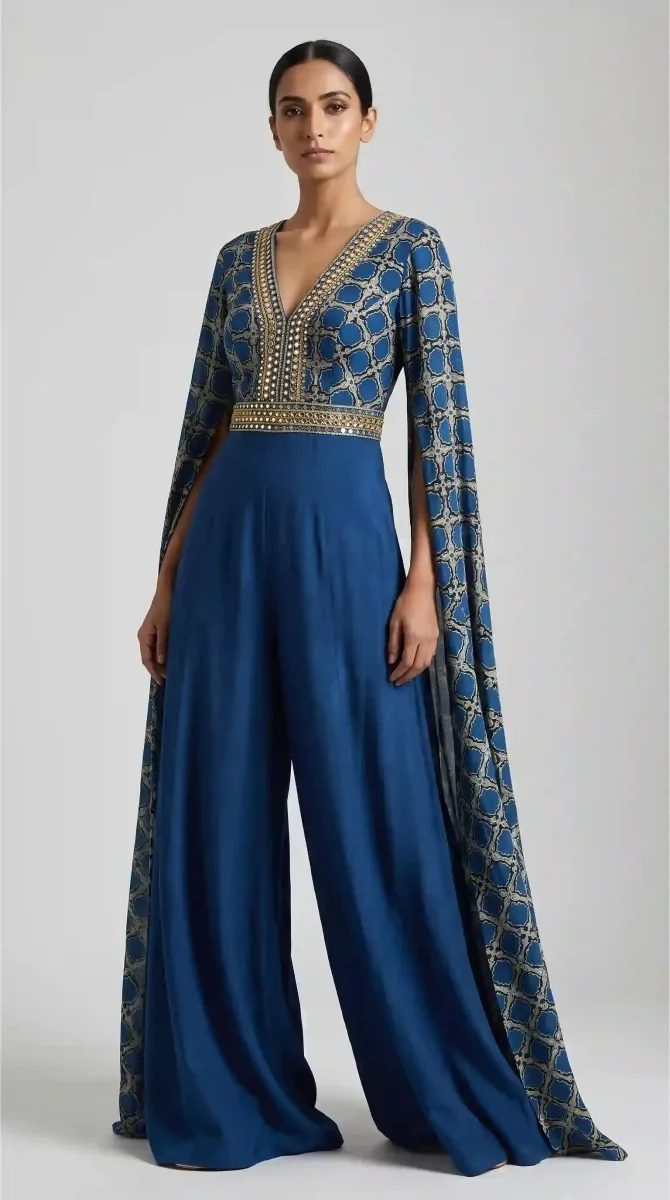
Separate pieces let you consider top and bottom fit independently; a jumpsuit connects their fit through the torso. Our RAABTA Yellow set has a kaftan and separate draped skirt, while our Blue Ajrakh bell-sleeve jumpsuit has joined construction and wide trouser legs.
| Criterion | Kaftan and draped skirt | Jumpsuit |
|---|---|---|
| Torso fit | Top length and volume are considered separately from the skirt. | Torso length connects shoulder, waist and crotch fit. |
| Garment volume | A flowing top can sit over a more closely draped bottom. | Bodice, sleeves and trouser legs can each have different volume. |
| Waist and hips | The skirt still needs suitable waist and hip measurements. | Waist and hip ease must work with the connected bodice. |
| Fastening and dressing | Separate components can be put on individually. | The joined top and trousers are put on as one garment; fastening access affects ease. |
| Seated comfort | Skirt waist pressure and drape matter despite the loose top. | Torso ease and rise matter alongside waist and hip fit. |
| Movement | Skirt drape, sleeves and hem affect stepping and reaching. | Trouser width, torso ease, sleeves and hems affect movement. |
| Hem length | Top and skirt lengths can be considered independently. | Trouser and sleeve lengths need to suit shoes and movement. |
| Separate wear | Two components offer potential mix-and-match wear. | The main garment is reworn as one integrated outfit. |
Separate pieces versus connected torso fit
A flowing kaftan leaves the skirt responsible for much of the lower-body fit, so give its waist, hips and drape as much attention as the top. With a jumpsuit, consider the length from shoulder through waist to crotch alongside your bust and hip measurements.
Fastening, movement and rewear flexibility
Dressing ease depends on fastening access and construction. For movement, consider sleeve clearance and hems as carefully as body fit. For rewear, decide whether you prefer mixing separate pieces or styling one complete outfit differently.
Explore our handcrafted kaftan sets by their top-and-bottom combinations.
Measurements and movement checks before ordering
Bust, natural waist, fullest hips, shoulders and garment lengths matter for both silhouettes; a jumpsuit also needs attention to torso length, rise and inseam. New Mexico State University identifies the fullest bust, natural waist and fullest hips as core fitting measurements.
Measurements to discuss
| Kaftan-and-skirt consultation | Jumpsuit consultation |
|---|---|
| Bust and shoulder measurements for the top | Bust and shoulder measurements for the bodice |
| Natural waist and fullest hips for the skirt | Natural waist and fullest hips for the joined garment |
| Preferred kaftan length and upper-body volume | Torso length and the design’s required measuring method |
| Skirt length, drape and intended footwear | Rise, inseam, trouser length and intended footwear |
| Sleeve length and clearance during movement | Sleeve length and clearance during movement |
A jumpsuit can fit around the bust and hips yet pull when you sit because it lacks torso length or movement ease. Megan Nielsen’s fitting guidance explains the importance of additional torso ease for sitting. For crotch depth, NMSU’s trouser-fitting guidance advises sitting on a flat surface and measuring from the waist to that surface.
Sitting, reaching, stepping and walking
When assessing fit, check how the outfit feels through these movements:
- Sit: notice waistband pressure, torso pulling and how the skirt or trousers settle.
- Reach: check neckline coverage and sleeve interference, both forward and overhead.
- Step: assess whether the skirt drape or trousers allow a comfortable stride.
- Walk: wear your intended shoes and check that hems do not catch underfoot.
Choose the amount of volume you enjoy, including when shopping for plus sizes. Neither silhouette requires you to hide your shape.
Fabric, lining and handwork change the feel
Fabric weight, finish and construction matter more than the silhouette’s name. Our RAABTA Yellow set and Blue Ajrakh jumpsuit both use modal silk, but combine it with different cuts and handwork.
| Design | Fabric and design details | Price | Artisans and labour hours |
|---|---|---|---|
| Our RAABTA Yellow | Modal-silk Ajrakh kaftan with a separate draped skirt | ₹8,950 | Khatri Harun, Dhamadka / Ajrakhpur, Gujarat; 41–45 artisan labour hours |
| Our Blue Ajrakh bell-sleeve jumpsuit | Ajrakh modal-silk bodice and floor-length bell sleeves; modal-silk bottom, wide legs and mirror-work deep V-neckline | ₹11,500 | Mirror work by Irfan Khokar; 53–58 artisan labour hours |
The labour hours reflect artisan work, not dispatch lead times. Both designs are available in XS–6XL and with custom measurements, include complimentary WhatsApp consultation and require dry cleaning.
- Cotton and voile: useful for lighter-volume designs, depending on weave and weight.
- Silk and modal silk: options for fluid occasionwear; the fabric determines the fall.
- Georgette and crepe: useful where drape is important, with weight and finish affecting the result.
- Denim: often gives more structure than a light, fluid fabric.
Breathability and stretch depend on fabric and construction, while lining can change weight and flexibility. NMSU’s garment-construction guidance explains that interfacing and underlining can reinforce a silhouette, while a woven lining limits stretch.
Ajrakh, zardosi and mirror work are distinct crafts. Ajrakh is a printing craft; mirror work incorporates reflective mirrors into embroidery. The Office of the Textile Commissioner defines zardozi as elaborate metallic embroidery.
Handwork placement changes emphasis. Neckline work draws attention upwards; concentrated waist or hem work shifts the focal point and can add local weight. Our jumpsuit’s mirror-work V-neckline creates a focal point, while its long bell sleeves need room to move.
Match the outfit to the event and your rewear plans
A kaftan set can look as dressy as a jumpsuit for an Indian celebration. Dress code, fabric finish, handwork and coverage matter more than the category. UNESCO’s caftan heritage description also recognises the Moroccan caftan as special-occasion dress.
- Mehendi or festive gathering: our RAABTA set offers a flowing top with independent skirt fit. For seated or hands-on activities, pay particular attention to our jumpsuit’s floor-length bell sleeves.
- Wedding-guest event: choose our Ajrakh set if its print and draped silhouette suit the dress code, or our mirror-work jumpsuit if its deep V-neckline and wide legs suit your coverage and movement needs.
- Dinner: pair either with stable flats or a manageable heel and one jewellery focal point. A mirror-work neckline may need little additional neck jewellery.
- Relaxed or resort setting: a standalone kaftan or lighter set may suit the mood. A draped-skirt occasionwear set still needs accurate skirt fit.
For rewear, pair our Ajrakh kaftan top with an existing bottom, or the draped skirt with another top, where coverage and proportions work. Change a jumpsuit’s mood through footwear, earrings or a simple layer. In either case, match hem length to your shoes and event plans.
Frequently asked questions
Can white people wear a kaftan?
Yes, white people can wear a kaftan. Kaftans have varied cultural histories, so wear yours respectfully, acknowledge specific craft traditions where relevant and follow the host’s dress code at cultural or religious celebrations.
What is the difference between a jumpsuit and a romper?
In everyday fashion usage, a jumpsuit usually has trouser-length legs, while a romper has shorts. Both join the top and bottom in one garment, so torso length and movement ease still matter.
What is the difference between a kaftan and a robe?
A kaftan is a particular garment tradition and silhouette, while robe is a broader term for a loose outer garment. Modern fashion kaftans are often worn as dresses or tops; robes commonly wrap or open at the front, although historical forms overlap.
Order timing and your final choice
Add shipping transit and a try-on buffer to the 4–5 weeks of production before dispatch. Share your event date before purchase so we can confirm whether the timing works.
Plan backwards: production time + destination-specific shipping transit + time for trying on and any alteration.
We remake products when measurement errors are ours and assist with one complimentary alteration when incorrect measurements were supplied by the customer.
Choose a kaftan set if independent top-and-bottom fit, a flowing upper silhouette and component rewear matter most.
Choose a jumpsuit if you want an integrated outfit and its torso, rise and movement fit suit you.
Explore our Ajrakh jumpsuit and fit consultation to discuss measurements and event timing before ordering.