
TL;DR: For intimate at-home functions, the kaftan set vs saree debate tilts strongly towards kaftan sets for hosts. With India’s ₹1,800 billion occasionwear market shifting to smaller, comfort-led events, kaftan-draped skirt sets give better movement, quicker dressing and higher rewear value, while sarees still win on timeless tradition and emotional appeal.
Your house is buzzing at 7 am on roka day, and the kaftan set vs saree debate is still unresolved in your head. You’re checking on the caterer, guiding décor, answering relatives on video calls, and mentally running through aarti timings. Somewhere between the marigolds and mithai, your outfit has to keep up.
You want to look polished in every candid photo, but you also know you’ll be bending, lifting trays and sitting cross‑legged for the katha. You’re searching for a comfortable Indian outfit for hosting that doesn’t feel like “compromise clothes”. That’s exactly the space we design for at Swarna by Sangisathi.
India’s wedding and occasionwear market is now about ₹1,800 billion, growing 12% annually, and a big chunk of that is intimate, experience‑led, home celebrations, according to Purple Style Labs research quoted on our blazer trends journal. Fusion and lighter silhouettes are outpacing heavy traditional wear, especially for house pujas, rokas and relaxed mehendis.
We see this daily through our made‑to‑order pieces. Women want artisanal Zardosi, tissue silks and handwork, but on silhouettes that move with them. So the real question becomes: for these at-home moments, how does kaftan set vs saree honestly compare for comfort, formality, time and value?
The modern host’s outfit dilemma at home
Hosting a house puja, roka or mehendi today rarely means just sitting in one place. You’re greeting elders, checking if the chai is hot, coordinating photographers, and still expected to look “put together” from mangalsutra to mojris. That’s where the kaftan set vs saree decision starts to feel very real.
From heavy sets to easy silhouettes
Earlier, hosts often reached for heavy lehengas or fully pleated sarees. Now, younger women are moving to lighter, versatile looks. As Mint reports on young Indian shoppers, many are “ditching designer bling for versatile chic”, especially for smaller gatherings.
We see the same shift towards Indo‑Western blazer sets, draped skirts and kaftan co‑ords. Our own Indo‑Western blazer trends 2026 perspective calls fusion a “core growth engine”, because it lets you move, host and socialise without feeling weighed down.
Why kaftan sets enter the chat
Into this landscape steps the embellished kaftan‑draped skirt set, like our HALDAR‑style silhouettes. It offers full coverage, built‑in drape and drama, but without the constant adjusting a saree can demand. When the function is in your living room, that balance matters more than an overly formal look.
So for the modern host deciding on kaftan set vs saree, the goal isn’t to replace tradition. It’s to find the sweetest spot between movement, modesty, craft and camera‑readiness, all within the chaos of an at‑home celebration.
What should you wear for a house puja or at‑home function?
If you’re wondering what to wear for house puja, think about what the day actually looks like. You’ll spend long hours at home, moving between rooms, touching elders’ feet, possibly sitting on the floor for a havan, and stepping into the kitchen every now and then.
Key requirements for house pujas and rokas
The right outfit for these functions needs to tick a few non‑negotiables. You need modest coverage for rituals, breathable fabric for fans‑and‑AC weather, and ease for sitting cross‑legged. It should still look festive and photogenic, because these are core milestones in your family album.
- Easy to sit on the floor without fuss
- Enough coverage for bending and hugging guests
- Breathable, light fabrics for indoor heat
- Festive details that show up well in photos
Why hosts are moving past heavy sets
According to House of Chikankari’s festive trends, demand for handcrafted yet comfortable wear has jumped around 45%. Designer Aakriti notes that “lighter comfortable fabrics are gaining popularity”, echoing our own experience with softer silks and fluid drapes.
Women want clothes that respect rituals but also respond to real life. That’s why many now skip very heavy sarees and lehengas at home, choosing fusion options that feel celebratory but practical. The kaftan set vs saree question sits right at this turning point.
- Traditional sarees for strong cultural signalling
- Embroidered kaftan sets for ease and flow
- Draped skirt sets and saree‑blazers as middle ground
Within Swarna by Sangisathi, we created kaftan‑draped skirt sets precisely for this mix of ritual and realism. Our embroidered kaftans pair with pre‑draped skirts, giving you full coverage without needing a petticoat or complicated pleating.
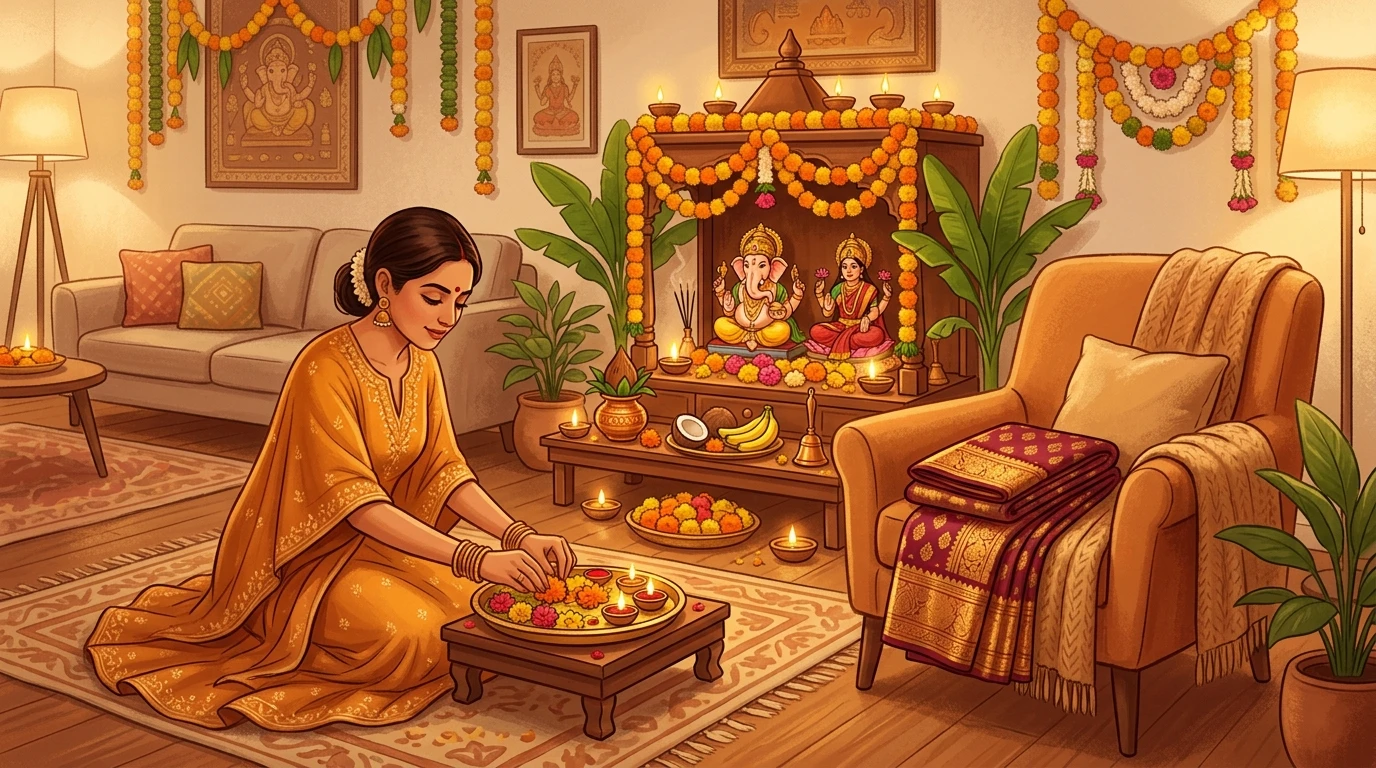
Kaftan set vs saree: Which is more comfortable and practical for hosting?
For pure comfort and practicality while hosting, kaftan set vs saree rarely ends in a tie. A well‑cut kaftan set almost always gives you more movement, less fuss and better ease across body types, especially during long, multitasking home events.
Movement, breathability and floor‑sitting
Comfort for at‑home events means you can walk quickly between rooms, sit on the floor, get up often, and handle trays without fear of anything slipping. Post‑pandemic, Cotton Culture’s trend report highlights this shift to lighter fabrics and easier silhouettes.
Our kaftan‑draped skirt sets are cut to skim rather than cling. No tight waistbands, no bulky petticoats, and no heavy, multi‑layered can‑can. When you sit cross‑legged during the katha, the drape fans out gracefully and stays in place, unlike saree pleats that can open or tug.
Body‑positivity and size‑flexibility
One of the biggest wins in the kaftan set vs saree comparison is body confidence. Kaftans naturally suit a wide range of bodies, including post‑partum shapes and fluctuating sizes. You’re not negotiating with a tight blouse or relying on shapewear just to feel secure.
As Cink’s fusion wear analysis notes, relaxed, size‑inclusive cuts are becoming a key differentiator for festive brands. Our own kaftan sets, like the Prava Kaftan Dhoti Pants Set from our kaftan line-up, are designed to flex with you, not against you, on busy hosting days.
Emotional pull vs all‑day wear
Sarees absolutely win on emotional value. They carry memories, blessings and stories. But for all‑day at‑home wear, they can feel demanding—especially if you aren’t a very confident draper. Constantly checking your pallu can distract from actually enjoying the rituals.
“We’re seeing a very clear shift in India toward lighter, more versatile occasionwear,” says Ashray Gujral, Founder of Dash and Dot, in his interview with Mint. That’s exactly why, on comfort and practicality for hosting, kaftan sets are the clear winner.
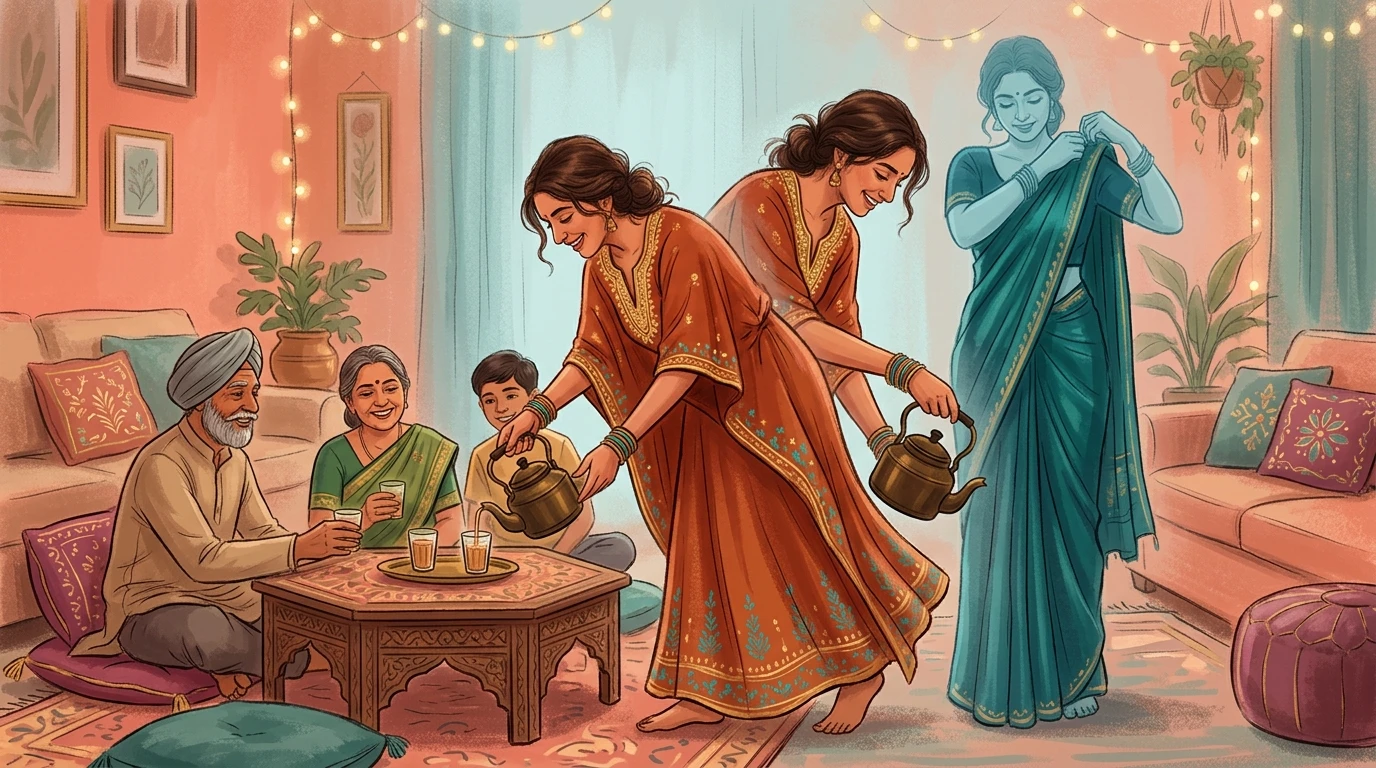
Who looks more dressed up: kaftan-draped skirt set or saree?
On perceived formality, sarees still have a strong hold. For many elders, they remain the most auspicious choice. But a richly embroidered kaftan-draped skirt set can look just as polished, especially if you’re eyeing a kaftan set for small wedding events like rokas or home mehendis.
How each silhouette reads in photos
Sarees create a long, vertical line that feels timeless in photographs. They suit classic roka backdrops, traditional mandaps and older family albums. In contrast, a kaftan set tends to look more editorial and Indo‑Western, which many of our clients in the UK, USA and Middle East love.
At Swarna by Sangisathi, we elevate kaftan sets with tissue silks, deep jewel tones and hand‑done Zardosi, so they photograph with the same richness as heritage sarees. Younger guests often comment that our HALDAR‑style kaftans “feel like couture, but breathable”.
- Saree: classic, auspicious, always familiar to elders
- Kaftan set: contemporary, global, very Instagram‑friendly
- Best group photos: one or two sarees, one or two kaftans
For ultra‑traditional rituals where symbolism matters more than practicality, sarees still win. But for modern, intimate house parties or sangeet‑meets‑cocktail evenings at home, a well‑crafted kaftan-draped skirt set can look just as dressed up—and a lot more unique.
How do kaftan sets and sarees compare on time, effort and ease of dressing?
When you’re the host, you’re usually the last person to get ready. That’s when kaftan set vs saree stops being theoretical and becomes a mirror‑and-clock reality. You may only have 20–30 minutes between checking décor, briefing staff and welcoming the first guests.
What it takes to wear a saree well
To look sharp in a saree, you need a well‑fitted blouse, a matching petticoat, and time for neat pleats and pins. Experienced drapers can do this quickly, but many still rely on a mom, sister or draping artist. Pre‑stitched sarees help, but they are a separate category altogether.
If anything feels off—tight blouse, uneven pleats, slipping pallu—you’ll be aware of it the entire function. That’s not the kind of background stress a host needs when handling rituals and guests.
Why kaftan sets feel almost “zip‑and‑go”
With our kaftan-draped skirt sets, dressing time drops dramatically. The pre‑draped skirt usually has a side zip or elasticated waist; the kaftan top slips on easily. Built‑in coverage means there’s no extra fuss with shawls or dupattas, unless you want them for styling.
Post‑pandemic, Cotton Culture notes a visible rise in ready‑to‑wear fusion silhouettes for this very reason. Our clients often tell us they can get fully ready in under 15 minutes in a kaftan set—hair and makeup included.
- Saree: multiple components, often needs help
- Kaftan set: two pieces, minimal adjustment
- Best for rushed, multitasking hosts: kaftan, every time
So on time, effort and ease of dressing, the kaftan set vs saree verdict is straightforward. If you’re the main organiser, a kaftan set is the more forgiving, realistic choice.
Are kaftan sets or sarees better value for money?
Value goes beyond the price tag. It’s about how often you’ll wear a piece, how many ways you can style it, and whether it works for travel. When we look at kaftan set vs saree through this lens, kaftans often come out ahead for frequent hosts.
Cost‑per‑wear and versatility
A heavy tissue silk or Zardosi saree might see daylight only at big weddings. For house pujas or casual dinners, it can feel too formal. You may love it, but realistically, it spends more time in your wardrobe than in your life.
A kaftan set for small wedding events, on the other hand, is easier to repeat. Wear it for a roka at home, re‑style the kaftan with denims for a brunch, and pair the draped skirt with a crop top for a resort holiday. That’s rewearable luxury.
How shoppers are thinking about investment pieces
As The Economic Times notes on fusion wear, western and Indo‑Western pieces are outpacing fully traditional silhouettes, because buyers want outfits that stretch across occasions. Our clients often build small capsules where one kaftan set works for multiple functions.
We see women pairing our kaftan skirts with structured blazers, inspired by our own blazer sets, or layering kaftan tops over plain silk pants for Diwali dinners. This flexibility makes the cost‑per‑wear of kaftans impressively low over time.
Which Should You Choose: Kaftan Set or Saree?
So when you stack up kaftan set vs saree, how do you finally decide? The best answer depends on your role, comfort, climate and how traditional the function feels for your family.
A simple decision framework
Start with a few questions. Are you the main host or mostly a guest? Do you feel relaxed draping a saree, or does it still make you nervous? Will you be sitting on the floor for long stretches? Is the weather humid? How traditional are your elders’ expectations?
- More boxes under comfort, movement and time‑saving → choose a kaftan set
- More boxes under symbolism, heirloom and family expectations → choose a saree
For NRIs and international guests, we usually nudge gently towards kaftan sets. They’re travel‑friendly, less size‑sensitive, and easy to re‑style for dinners back in the UK, USA, Australia or Europe.
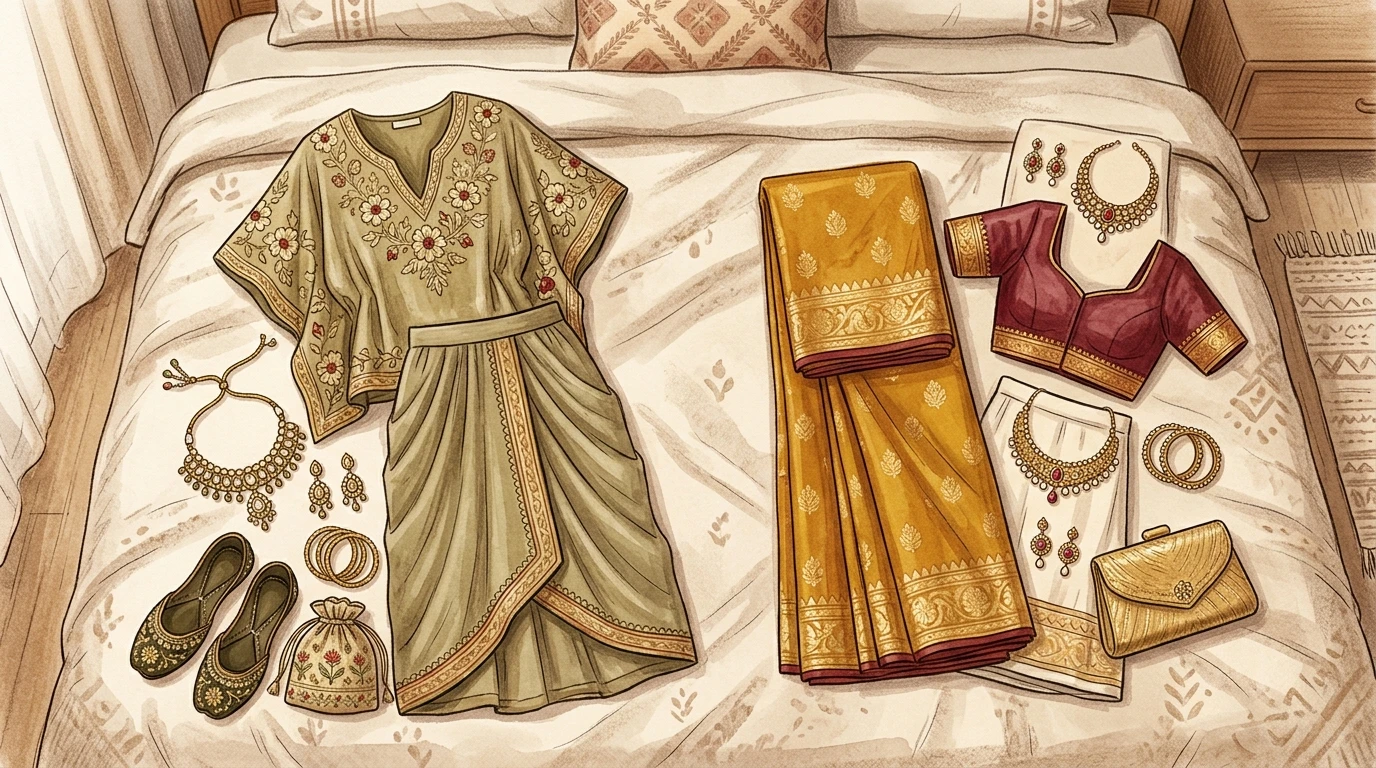
Side‑by‑side: Quick comparison table
This quick overview sums up how a kaftan set vs saree usually plays out for intimate at‑home events like house pujas, rokas and mehendis.
| Aspect | Kaftan Set | Saree |
|---|---|---|
| Comfort for hosting | Relaxed fit, breathable, easy floor‑sitting | Depends on drape; pleats and pallu can restrict |
| Time to get ready | Fast, almost zip‑and‑go | Needs draping time and practice |
| Formality level | Modern festive, Indo‑Western | Highly traditional and auspicious |
| Body‑friendliness | Size‑flexible, skims the body | Relies on fitted blouse and petticoat |
| Rewear value | High; easy to mix‑and‑match | Best for specific traditional events |
Frequently Asked Questions
Is a kaftan set or saree better for a house puja at home?
For most hosts, a kaftan set is better for a house puja because it allows easier movement, floor-sitting and long hours of wear. Sarees are beautiful and traditional, but they often need more adjustment and confidence with draping. If you’ll be multitasking between rituals and guests, a kaftan set usually feels more practical.
What is the most comfortable Indian outfit for hosting a roka or mehendi at home?
A lightweight kaftan-draped skirt set is one of the most comfortable Indian outfits for hosting rokas or mehendis at home. It combines full coverage with breathable fabrics and doesn’t rely on tight blouses or heavy petticoats. You can bend, serve, and dance without worrying about pleats or pallus slipping.
Can I wear a kaftan set for small wedding functions instead of a saree?
Yes, you can absolutely wear a kaftan set for small wedding functions like rokas, home mehendis and intimate sangeets. Choose one with rich embroidery or luxe fabrics so it feels dressy enough for photos. Kaftan sets also rewear well for later occasions, making them a strong value choice versus a single-use heavy saree.
What to wear for house puja if I need to sit on the floor?
If you’ll be sitting on the floor for a house puja, pick outfits with ease around the hips and knees. Kaftan sets and soft draped skirts are ideal because they fan out comfortably and don’t pull when you sit cross-legged. Avoid very tight fits or stiff fabrics that restrict movement.
How does a kaftan set vs saree compare for plus-size bodies?
For plus-size bodies, kaftan sets are usually more forgiving than sarees. They skim the body instead of clinging, and the fit is less dependent on a perfectly tailored blouse or petticoat. Sarees can look stunning too, but they often require more structured underlayers, while kaftans give instant comfort with less tailoring.
Conclusion: Dress like the host, not the mannequin
Across comfort, movement and time to dress, kaftan sets clearly outshine sarees for at‑home hosting. On tradition and symbolism, sarees still hold their throne. When you weigh kaftan set vs saree for your next house puja or roka, the right answer is the one that lets you participate fully, not just pose.
At Swarna by Sangisathi, we pour age‑old craft into host‑friendly silhouettes—embroidered kaftan sets, draped skirts and Indo‑Western pieces that respect rituals while respecting your reality. If you’re planning upcoming house pujas, mehendis or a kaftan set for small wedding functions, our kaftan sets collection is a thoughtful place to start.
Explore the handcrafted details, imagine how you’ll move through your home, and shortlist the pieces that feel like your most comfortable Indian outfit for hosting. When you’re ready, you can order made‑to‑measure with global shipping directly from Swarna by Sangisathi, so your next celebration feels as effortless as it looks.